The deepening page
Nicholas Carr The Shallows 4 the deepening page
This chapter basically says:
“The book did not just store knowledge.
It redesigned the human nervous system.”
Humans invented deep reading…
and accidentally created philosophers, scientists, existential crises, and people who buy too many books because “this one will finally fix me.”
Chapter 4 of The Shallows might be the emotional center of the book so far.
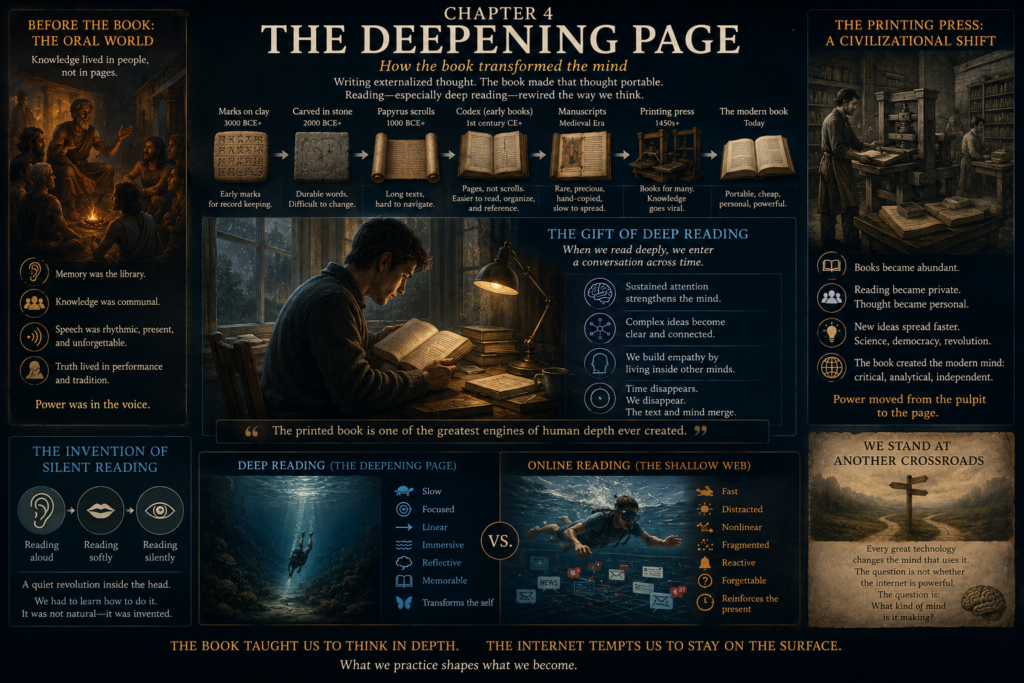
Carr traces the evolution from primitive marks on clay and stone to the invention of the modern book — and shows that reading itself became a cognitive technology.
Not just a way of storing thoughts.
A way of reshaping thought.
Early writing systems were awkward, fragmented, and difficult to navigate.
Scrolls were cumbersome.
Words often lacked spaces.
Reading was usually performed aloud.
That part fascinated me.
We forget that silent reading is actually a learned technological behavior.
Humans had to invent the mental machinery for it.
And once people learned deep reading,
something extraordinary happened:
the brain developed the ability to sustain attention for long stretches,
build internal narratives,
follow complex chains of thought,
and create rich inner worlds.
This is where the chapter becomes almost spiritual.
Carr describes how deep reading creates a state where the reader disappears into the text.
You stop noticing the room.
Time dissolves.
The author’s thoughts merge with your own internal voice.
Honestly…
that feeling is one of the great human experiences.
And it suddenly explains why modern internet reading often feels emotionally thin by comparison.
The web trains interruption.
Books train immersion.
Carr also shows how the printing press transformed civilization itself.
Cheap books expanded literacy,
private reading,
individual interpretation,
scientific thinking,
and intellectual independence.
The book became a machine for deep consciousness.
That sentence sounds dramatic —
but after this chapter it genuinely feels true.
One section I especially liked was the idea that different media encourage different kinds of minds.
The oral world emphasized memory,
rhythm,
speech,
presence,
and communal experience.
The book encouraged solitude,
analysis,
linear reasoning,
and introspection.
And then Carr quietly asks the dangerous modern question:
What kind of mind does the internet encourage?
Fast.
Reactive.
Distracted.
Connected.
Efficient.
But perhaps less contemplative.
The ending feels almost melancholic.
Carr suggests we are once again standing between two cognitive worlds,
just as people once stood between oral culture and print culture.
And maybe that is why many people today feel mentally fragmented.
Part of the brain still longs for the deep page.
While another part keeps refreshing the feed.