
Five a medium of the most general nature
Nicholas Carr – The Shallows – Five.
Five a medium of the most general nature.
This chapter basically says:
“The internet did not arrive as one technology.
It arrived as ALL technologies at once.”
Library.
TV.
Radio.
Newspaper.
Phone.
Cinema.
Office.
Social life.
Humanity connected everything into one glowing rectangle…
and then wondered why nobody could focus anymore.
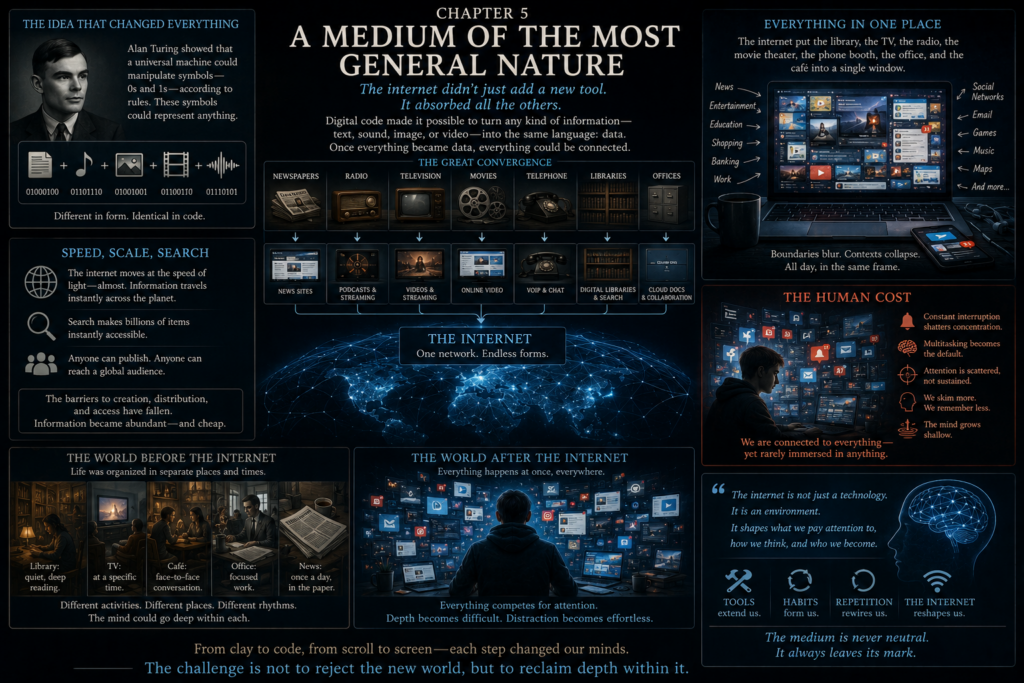
Chapter 5 of The Shallows feels like the moment where the internet stops being “a tool” and starts becoming an environment.
Carr begins with Alan Turing and the revolutionary idea behind digital computing:
all forms of information can become the same thing once translated into code.
Text.
Music.
Images.
Film.
Voice.
Memory.
Everything becomes data.
And once everything becomes data,
everything can merge together into one medium.
That is the real turning point.
The internet is not just another communication technology.
It absorbs all previous media into itself.
Carr walks through this transformation almost historically:
newspapers become websites,
radio becomes streaming,
TV becomes clips,
music becomes files,
libraries become searchable databases,
social interaction becomes platforms.
And slowly the boundaries between activities collapse.
Work.
Entertainment.
Learning.
Friendship.
Consumption.
Identity.
Everything starts happening in the same window.
Honestly,
this chapter explains modern mental exhaustion better than many psychology books.
Because the human brain evolved around contextual separation.
You left the marketplace.
You entered the church.
You went home.
You sat with a book.
Now everything lives simultaneously inside the same device.
Carr also points out something subtle but important:
the internet constantly rewards speed,
novelty,
fragmentation,
and interruption.
Even traditional media begins adapting itself to internet logic.
Articles become shorter.
TV becomes faster.
Books become marketed through distraction systems.
Everything competes for attention.
The medium reshapes the content.
Again.
One part I really liked was the discussion about hyperlinks and multitasking.
Links are useful —
but they constantly whisper:
“Leave this thought.
Something else may be more interesting.”
And eventually the brain internalizes that rhythm.
The result is a strange modern condition:
continuous partial attention.
We are connected to everything,
yet fully immersed in almost nothing.
The library example near the end is honestly a little sad.
Libraries once symbolized silence,
depth,
concentration,
private reflection.
Now many libraries increasingly resemble information hubs filled with screens,
notifications,
public terminals,
and network access.
Even the architecture of knowledge changes shape around the internet.
And perhaps that is the deepest point of the chapter:
The internet does not merely change what we do.
It changes the atmosphere inside which thinking itself occurs.