A medium of the most general nature
Nicholas Carr – The Shallows – chapter 6
A medium of the most general nature
This chapter basically says:
“Humans did not invent multitasking because it was good for the brain.
We invented it because the machine made distraction profitable.”
The internet promised infinite access to knowledge…
and accidentally turned half the population into exhausted window managers.
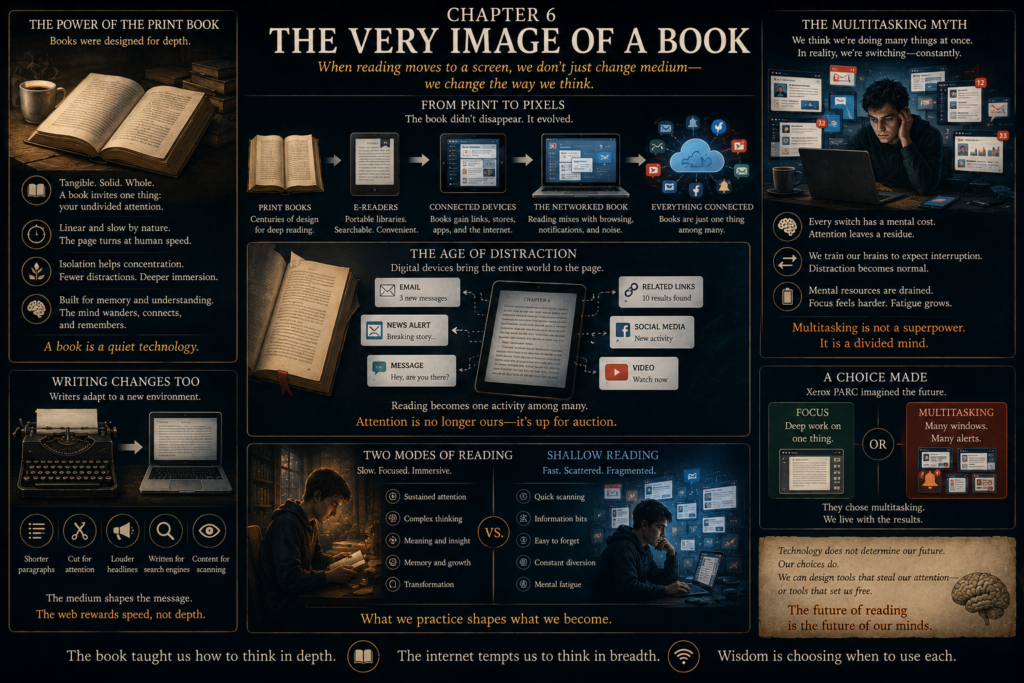
Chapter 6 of The Shallows feels strangely personal because it directly attacks one of the biggest modern myths:
the idea that humans become smarter by consuming more information faster.
Carr starts by discussing books themselves —
their physical form,
their tactile nature,
their slowness.
And honestly,
he makes books sound almost biologically compatible with the human nervous system.
A book waits for you.
It does not blink.
It does not notify.
It does not compete for your attention every six seconds.
You enter it voluntarily.
That alone now feels revolutionary.
Carr then examines e-books and devices like the Kindle.
At first he sounds fair and balanced:
digital reading has practical advantages.
Portable libraries.
Searchability.
Convenience.
But then comes the important shift:
once books become networked,
they stop being isolated reading experiences.
Links appear.
Notifications appear.
Search appears.
Messages appear.
Recommendations appear.
And suddenly reading becomes mixed together with browsing.
That distinction matters enormously.
Carr describes people trying to read deeply on connected devices while constantly interrupting themselves to check mail,
Google references,
open tabs,
follow links,
or drift into unrelated material.
Which honestly describes modern life with painful accuracy.
The chapter’s deeper argument is subtle:
attention is not merely interrupted by technology —
it is reprogrammed by it.
Every time we divide attention,
the brain practices divided attention.
And eventually distraction stops feeling unnatural.
It becomes normal.
Carr also explores how writing itself changes online.
Writers adapt to search engines,
short attention spans,
fragmented reading,
and algorithmic visibility.
Paragraphs become shorter.
Headlines louder.
Structure flatter.
Complexity reduced.
The medium reshapes authors as much as readers.
One part I found fascinating was the discussion about literary culture itself.
Some digital theorists almost celebrate the death of deep reading,
claiming long novels and contemplative literature are outdated relics from the print era.
Carr clearly disagrees —
and honestly,
so do I.
Because deep reading is not only about information transfer.
It is about learning how to remain inside complexity without fleeing from it.
That may actually be one of civilization’s most important mental skills.
The ending with the Xerox PARC story is brilliant.
Researchers debated whether computers should help humans focus deeply on one thing —
or juggle many things simultaneously through windows,
alerts,
and multitasking.
We know which vision won.
And Carr’s final observation hits quite hard:
modern humans did not merely inherit multitasking.
We culturally selected it.
Which means we also helped build the mental environment now exhausting us.