
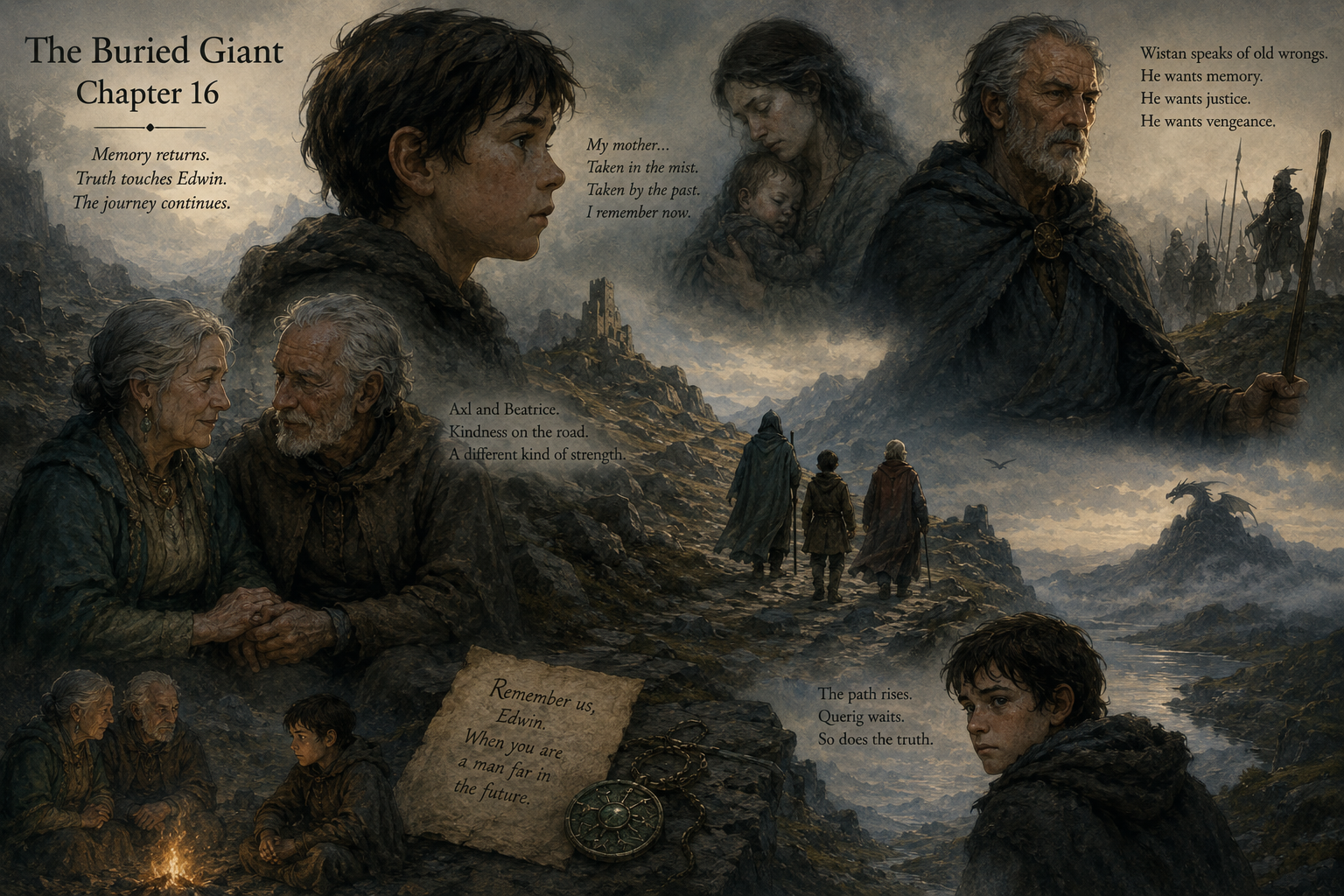
Kazuo Ishiguro – The Buried Giant Chapter Four
Chapter 4 feels like a medieval psychological stress test where Edwin is slowly transformed from frightened village boy into someone shaped by fear, isolation, and Wistan’s influence. The chapter quietly shows how societies create outsiders long before they understand what they are actually afraid of.
Chapter 4 feels like a medieval coming-of-age story filtered through trauma, superstition, and the world’s least healthy mentorship program. The focus shifts almost entirely to Edwin, and for the first time the novel begins exploring not only memory, but identity — how a person becomes shaped by fear, isolation, and the expectations others place upon them.
What struck me most is how differently Edwin experiences the world compared to Axl and Beatrice. The older couple drift through uncertainty softly and emotionally, but Edwin’s reality is immediate, physical, and brutal. The village already fears him because of the bite on his body, and slowly he begins internalising the idea that he may truly be different from everyone around him.
The scenes inside the barn are especially powerful. Edwin forcing himself to circle the wagon over and over while the noises outside grow louder creates an almost dreamlike psychological horror. Ishiguro never fully explains what is real and what is fear, memory, or suggestion. The creature itself matters less than Edwin’s growing need to survive and prove himself worthy in a world already prepared to reject him.
Wistan’s role also becomes much clearer in this chapter. He sees something in Edwin long before Edwin sees it in himself. The old warrior’s stories about courage and discipline begin shaping Edwin into someone very different from the frightened village boy we first met. Wistan almost treats him like raw material for the future — not with warmth exactly, but with recognition.
What I found most interesting is how the chapter explores exclusion. Nobody truly understands Edwin’s wound or what happened to him, yet suspicion alone is enough to isolate him socially. Fear creates its own truth. The villagers do not need certainty; they only need enough uncertainty to justify treating someone as dangerous.
The atmosphere throughout the chapter is tense but strangely restrained. Large dramatic events are still avoided, yet psychologically the chapter becomes much darker than earlier parts of the book. The mist no longer feels only like forgetfulness. It starts feeling like a force that allows old fears, myths, and buried instincts to quietly govern human behavior.
By the end of the chapter, Edwin no longer feels simply like a frightened child caught in events beyond him. He begins to feel like someone standing at the edge of transformation — shaped by fear, guided by Wistan, and unknowingly connected to whatever future waits beyond the fading mist.