
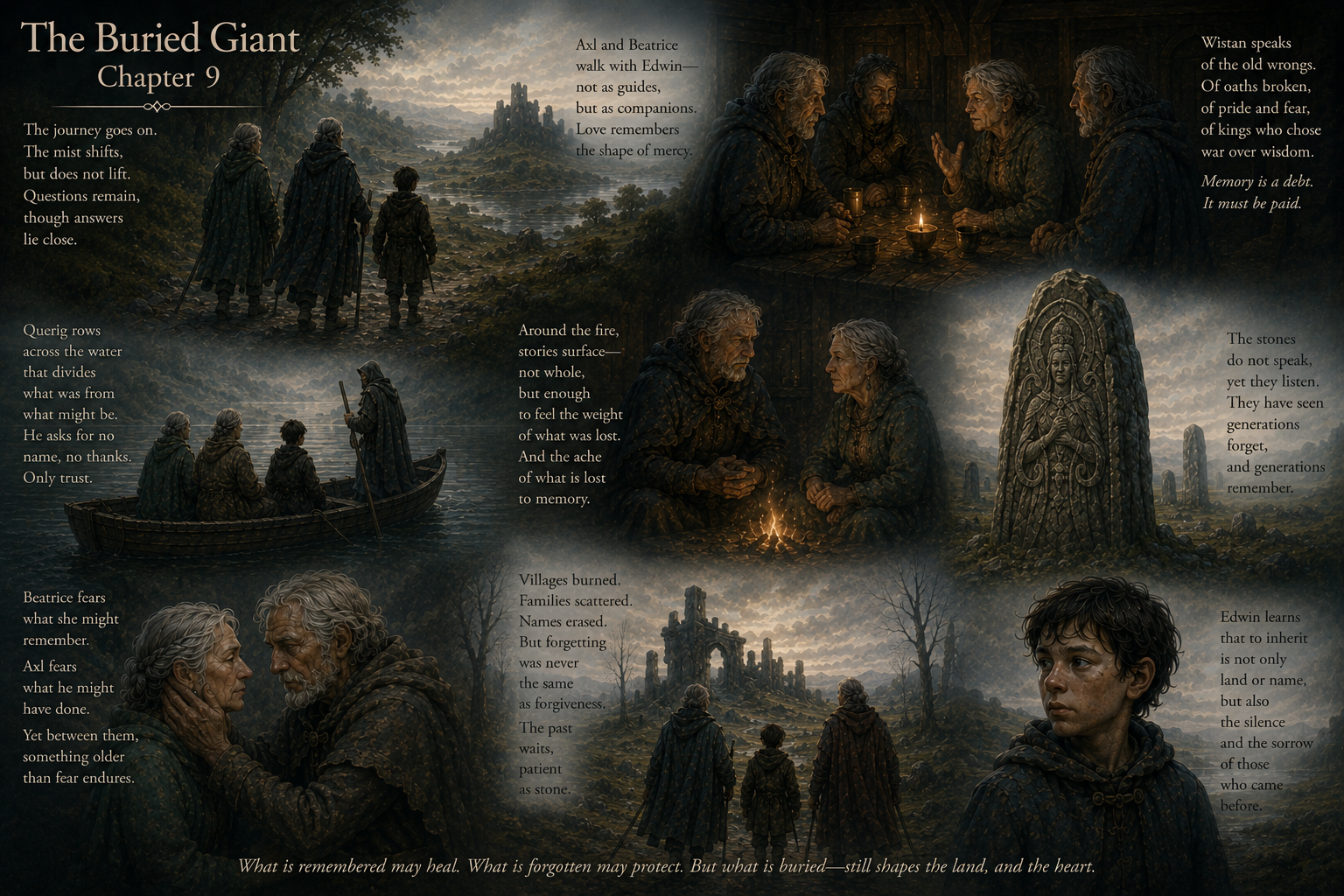
Kazuo Ishiguro – The Buried Giant Chapter 11.
Chapter 11 feels like two people trying to hold onto love while slowly drifting through a river made of memory, fear, and things better left under old blankets. Beneath the strange dreamlike atmosphere, the chapter quietly asks whether kindness and love are enough when truth finally begins returning.
Chapter 11 feels like the book quietly rowing itself into myth, dream, and emotional memory all at once, while Axl and Beatrice sit in separate baskets trying not to think about separation. After the political and historical tension of earlier chapters, the story suddenly becomes intimate again, but now intimacy itself feels fragile, haunted, and dangerous.
What struck me most is how strongly the chapter echoes the ferryman story introduced much earlier in the novel. The river crossing is not only physical transportation. It feels like a rehearsal for death, memory, and the possibility that two people who deeply love one another may still drift apart once truth fully returns. Ishiguro turns something as simple as two baskets on a river into one of the most emotionally tense scenes in the entire book.
Axl and Beatrice’s conversations in the baskets are especially powerful because they move constantly between tenderness and fear. They try to reassure one another, yet both sense that forgotten memories may contain wounds large enough to reshape their relationship entirely. The chapter repeatedly suggests that love can survive uncertainty more easily than complete knowledge.
The strange old woman in the larger boat creates one of the most unsettling symbolic moments in the novel. Ishiguro never fully explains whether she is entirely real, supernatural, symbolic, or partly imagined through the fog of memory and exhaustion. Her boat filled with rats, strange creatures, hidden movement, and whispers transforms the river journey into something almost mythological — like encountering the physical embodiment of buried suffering and forgotten guilt.
What fascinated me most is Axl’s reaction to her. At first he responds with ordinary kindness and compassion. He wants to help her because that is fundamentally who he is. But as the creatures emerge and the atmosphere becomes increasingly disturbing, the chapter forces him into an impossible moral situation: protect Beatrice or continue helping the suffering stranger.
This conflict becomes deeply symbolic. Throughout the novel Axl has tried to remain gentle, calm, and morally decent in a world built upon confusion and fading memory. Here he discovers that compassion itself may demand painful choices. The old woman repeatedly begs him not to abandon her, and her words sound almost like accusations directed not only at Axl, but at everyone who chooses safety while leaving others behind.
Beatrice’s role in the chapter is quieter but emotionally central. Her weakness, exhaustion, and fear make the possibility of separation feel increasingly real. Yet even in moments of confusion, she continually reaches toward Axl emotionally. Their bond still exists, but it now feels vulnerable to forces larger than either of them fully understands.
The atmosphere throughout the chapter is dreamlike in a very different way from earlier parts of the novel. Earlier dreamlike scenes often involved fog, uncertainty, or fading memory. Here the dream quality becomes almost mythic and spiritual. The river, the reeds, the baskets, the drifting boats, and the creatures hidden beneath blankets all feel loaded with symbolic meaning beyond ordinary reality.
I also noticed how the chapter quietly returns to one of the novel’s deepest themes: forgetting may protect people emotionally, but it also leaves suffering unresolved somewhere beneath the surface. The old woman’s desperate pleas almost sound like memory itself refusing to remain buried any longer.
Reading the chapter slowly creates a powerful emotional tension because almost nothing is fully explained. Ishiguro allows fear, pity, tenderness, guilt, and uncertainty to exist together without forcing clear interpretation. The fantasy elements become more surreal, yet emotionally the story feels more human than ever.
By the end of the chapter, Axl and Beatrice remain together physically, but the river crossing makes something painfully clear: the closer they move toward recovered memory and truth, the more fragile their shared future begins to feel.