
Kazuo Ishiguro – The Buried Giant Chapter 15.
Chapter 15 feels like the entire book finally sitting down around the same fire and admitting nobody actually agrees on what peace, justice, or mercy really mean. As Gawain and Wistan openly confront each other beside Querig’s mountain, the dragon almost stops being the real enemy — memory itself becomes the dangerous force everyone fears differently.
Chapter 15 feels like the entire novel finally climbing onto the same mountain carrying different definitions of peace, justice, memory, and revenge — while one exhausted old knight desperately tries to slow history itself with diplomacy, nostalgia, and a very stubborn horse. The chapter is long, dense, and emotionally heavy, but it may also be the clearest moment where all the novel’s moral conflicts stand fully exposed beside Querig’s lair.
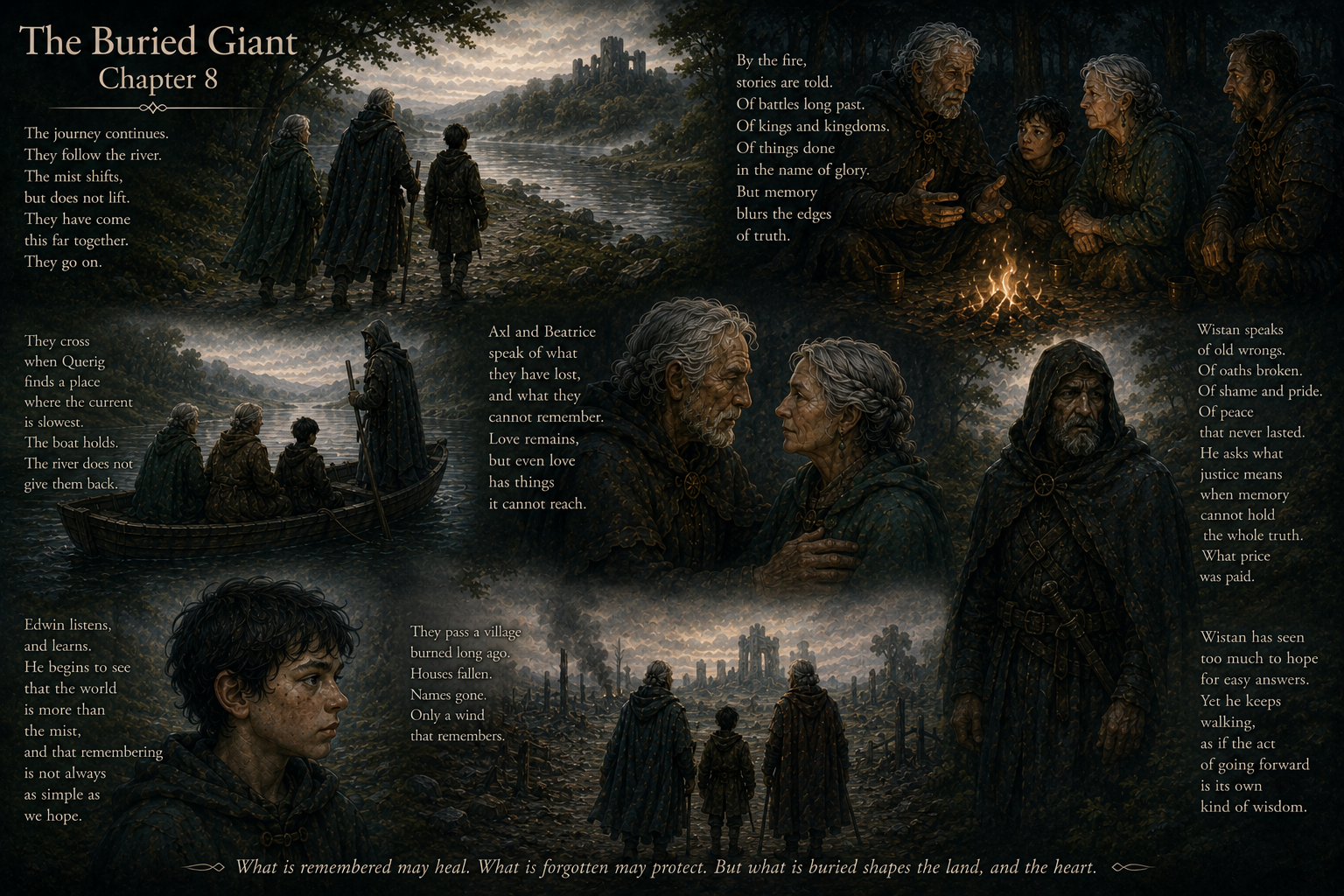
What struck me most is how openly the characters now speak compared to earlier chapters. For much of the novel everyone moved through fog, uncertainty, half-memories, and indirect conversations. Here the masks begin falling away. Wistan, Gawain, Axl, Beatrice, and Edwin all increasingly reveal what truly drives them beneath politeness and restraint.
Gawain’s role becomes deeply tragic in this chapter. He no longer appears merely as guardian of Querig, but almost as the final guardian of an entire historical compromise. He knows Arthur’s peace was built upon atrocities against Saxons, yet he still believes that reopening those wounds may doom future generations to endless cycles of revenge. His arguments are not presented as cowardice, but as the exhausted wisdom of someone who has seen too much killing already.
Wistan, however, now stands fully revealed as Gawain’s opposite. For him, forgetting is itself a moral failure. Peace built on buried massacres is not peace at all, only suspended violence. What makes the chapter powerful is that Ishiguro refuses to let either man become completely right or wrong. Both understand truth. Both fear the future. They simply fear different things more deeply.
The conversations between Wistan and Gawain almost feel like two historical eras arguing with each other. Gawain represents stability, restraint, compromise, and the painful acceptance that history sometimes demands morally terrible bargains. Wistan represents memory, justice, identity, and refusal to let suffering disappear into political convenience.
Edwin’s role becomes increasingly important because he stands emotionally between these two worldviews. Earlier he mostly admired Wistan without question. Now he begins understanding the cost of carrying inherited hatred forward. His memories of his mother return more clearly, and for the first time he openly questions whether vengeance can ever truly repair what violence destroys.
One of the strongest elements in the chapter is how often ordinary human tenderness interrupts the larger ideological conflict. Axl worrying about Beatrice’s cold hands, Beatrice comforting Edwin, Gawain speaking softly to his horse, moments of shared exhaustion beside fires — these scenes constantly remind the reader that beneath wars and historical systems exist fragile human beings simply trying to survive emotionally.
The mountain environment intensifies everything psychologically. The wind, cliffs, rocks, caves, and harsh weather create the feeling that all comforting illusions have been stripped away. Earlier parts of the novel allowed characters to wander, delay, and avoid direct confrontation. Here there is nowhere left to hide. Every path leads toward Querig, memory, and consequence.
Beatrice’s emotional role also becomes central in a quieter way. Her growing fear is not primarily about dragons or physical danger. She increasingly fears what recovered memory may do to her relationship with Axl. Throughout the chapter she repeatedly seeks reassurance that love can survive whatever truths wait ahead. That fear gives the novel its deepest emotional core.
What fascinated me most is how the chapter slowly transforms Querig herself into something almost secondary. The dragon matters enormously, yet the true conflict now exists between human responses to memory. Should terrible history remain buried if uncovering it only creates new hatred? Or does forgetting itself slowly poison both justice and identity?
Gawain’s reflections about Arthur are especially painful because they reveal genuine loyalty mixed with moral doubt. He still loves the king he served, still believes Arthur wished for peace, yet can no longer avoid remembering the innocent people slaughtered to achieve it. His entire life begins to look like a burden carried in defense of something both necessary and unforgivable.
The chapter also changes Edwin permanently. By the end, he no longer feels like a child observing older people’s conflicts. He has begun forming his own moral position. He understands now that hatred can survive through stories, identities, and inherited memory long after battles themselves end.
Reading the chapter slowly creates the sensation that the novel has reached its moral summit before its physical one. Almost every major theme now stands exposed: memory versus forgetting, justice versus peace, loyalty versus truth, compassion versus vengeance, and love versus the damage hidden inside memory itself.
By the end of the chapter, the journey toward Querig no longer feels like a quest to slay a dragon. It feels like humanity approaching the point where history returns all at once, asking whether people truly want the truths they spent generations burying beneath the mist.