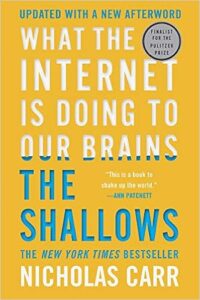
Nicholas Carr The Shallows One Hal and Me
This chapter is basically Nicholas Carr realizing:
“I went online to check one thing in 2003…
and accidentally outsourced my entire brain.”
The internet promised infinite knowledge but somehow turned humans into creatures emotionally unable to read three pages without checking another tab.
Chapter 1 of The Shallows starts with one of the most unsettling modern feelings:
the quiet suspicion that your own mind is changing.
Carr compares himself to HAL from 2001: A Space Odyssey —
not because he is dying,
but because he feels his mind slowly being rewired by technology.
What makes the chapter powerful is that he does not describe dramatic collapse.
He describes something smaller and far more believable:
the inability to stay inside a thought.
He explains how deep reading became harder.
Books that once pulled him into long concentration now felt difficult to remain inside. His mind wanted stimulation, movement, interruption.
And honestly…
almost everybody recognizes this now.
You open a browser to check one fact.
Twenty minutes later you somehow know:
• the history of Mongolian throat singing
• which synthesizer Vangelis used in 1982
• weather in Riga
• and why octopuses punch fish out of spite
while completely forgetting the original task.
Carr argues that the internet doesn’t simply give information.
It trains the brain into a new rhythm:
fast,
fragmented,
restless.
The most interesting part is that many highly educated people in the chapter describe the exact same thing:
difficulty reading long texts,
reduced patience,
constant scanning instead of immersion.
The internet rewards efficiency,
but deep thinking is often inefficient.
A real thought usually needs silence,
slowness,
wandering,
and boredom before it becomes meaningful.
The web hates boredom.
It feeds the brain tiny rewards constantly.
Carr also describes his own technological evolution —
from bookshelves and libraries to hyperlinked digital existence.
And the transition sounds almost nostalgic,
like someone describing how a quiet room slowly filled with machines.
The saddest line in the chapter may actually be the simplest:
“I missed my old brain.”
Because that sentence is not really about technology.
It is about identity.
Who are you,
if the way you think changes?