Vital paths
Nicholas Carr The Shallows two vital paths
This chapter basically says:
“Your brain is less like a stone statue…
and more like a forest path.”
The more often you walk one trail, the easier it becomes —
which explains both Beethoven becoming Beethoven and humans instinctively opening YouTube during existential crises.
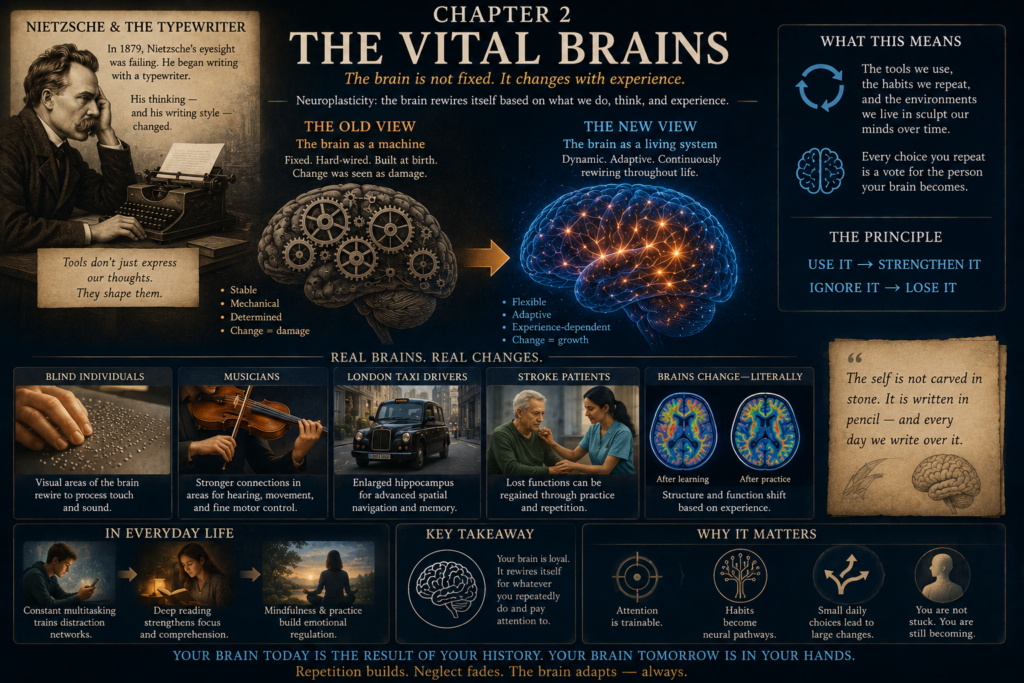
Chapter 2 of The Shallows is fascinating because Carr stops talking about the internet itself and instead explains something far more important:
the brain physically changes depending on how we use it.
Not metaphorically.
Literally.
The chapter starts with Friedrich Nietzsche, who began using a typewriter because of failing eyesight.
At first this sounds like a small historical detail.
But then Carr reveals something strange:
Nietzsche’s writing style itself changed after he began typing.
The machine altered the rhythm of thought.
That idea is honestly a little terrifying.
Because humans like to imagine:
“I use tools.”
But the chapter quietly asks:
“What if tools also use us?”
Carr then moves into neuroscience and neuroplasticity —
the discovery that the brain constantly rewires itself based on experience.
Older science imagined the brain as something mechanical and fixed:
a machine with stable parts.
Modern neuroscience instead suggests something far stranger:
the brain behaves almost like living clay.
Every repeated action strengthens certain neural pathways.
Every habit becomes easier the next time.
Which suddenly makes modern internet behavior much more serious.
Because if attention itself is trainable,
then distraction is also trainable.
And maybe that is the real fear inside the book:
not that humans are weak,
but that the brain adapts loyally to whatever environment it lives inside.
Carr gives several incredible examples:
blind people rewiring sensory areas,
musicians physically reshaping parts of the brain,
London taxi drivers developing enlarged spatial-memory regions,
stroke victims rebuilding functions through repetition.
The message becomes impossible to ignore:
what you repeatedly do becomes part of what you are.
Not spiritually.
Biologically.
I also liked how the chapter quietly destroys one comforting illusion:
the idea of a permanent “true self.”
The brain is dynamic.
Fluid.
Adaptive.
Which means modern technologies are not just tools sitting outside us.
They slowly become architects inside us.
And honestly…
that may be one of the most important ideas in the entire book.