
Nicholas Carr The Shallows 3 tools of the mind.
This chapter basically says:
“Civilization is just humans outsourcing memory one invention at a time.”
First maps remembered the world for us.
Then clocks remembered time.
Then books remembered thoughts.
Now phones remember everything except why we walked into the kitchen.
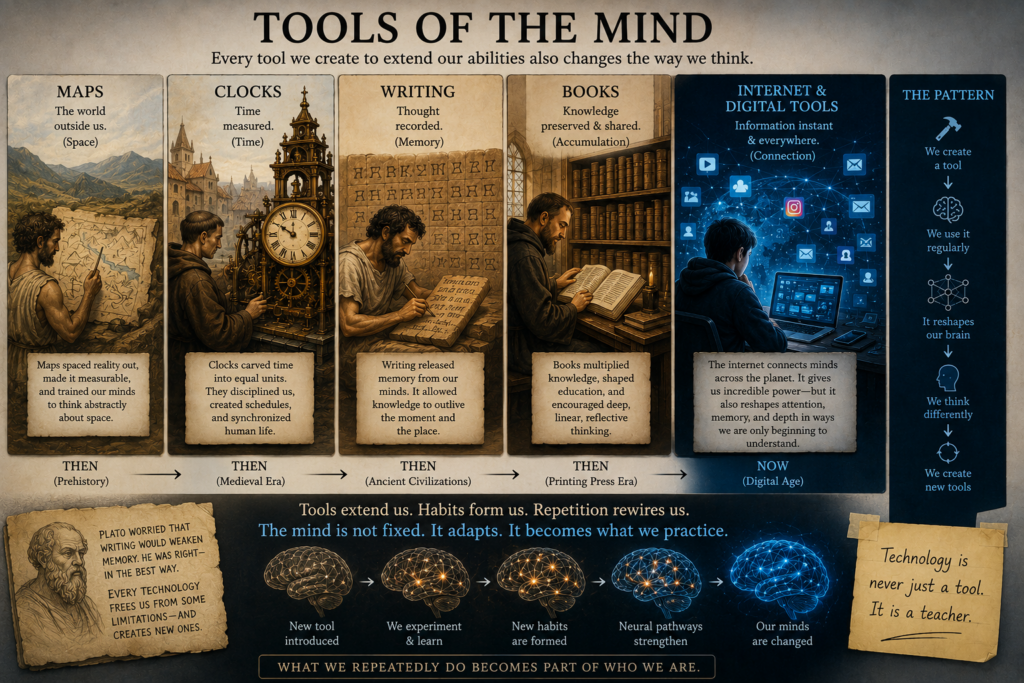
Chapter 3 of The Shallows is probably the most important chapter so far because Carr shows that tools are never merely practical.
They quietly reshape human consciousness itself.
The chapter begins with maps.
At first humans drew simple symbolic sketches.
Over time maps became increasingly abstract, mathematical, and precise.
And something strange happened:
people began thinking differently because of the maps.
The map did not merely represent reality —
it trained the brain to perceive reality through abstraction.
That idea becomes the core of the whole chapter.
Carr then moves to clocks,
which may secretly be one of the most influential technologies in human history.
Before mechanical clocks,
time was fluid.
Organic.
Connected to sunlight,
weather,
bells,
prayer,
seasons,
and human rhythms.
Then clocks divided life into measurable units.
And humans slowly started organizing themselves like machinery.
Which honestly explains modern corporate calendars frighteningly well.
The clock did not simply measure time.
It industrialized attention.
Carr also discusses how intellectual technologies —
maps,
clocks,
writing,
books —
expand human capability while simultaneously changing the structure of thought itself.
This is where the book becomes genuinely profound.
Because we usually think:
“I use technology.”
But Carr keeps showing the reverse:
technology slowly teaches humans how to think.
The chapter’s sections on writing and literacy were especially fascinating.
Plato feared writing because he believed external memory would weaken internal memory.
And honestly…
he was not entirely wrong.
Writing changed human consciousness dramatically.
Reading reshaped memory,
logic,
attention,
language,
and even the physical wiring of the brain.
Carr’s larger point becomes impossible to miss:
Every major information technology rewires the human mind.
Not eventually.
Immediately.
Quietly.
Structurally.
And perhaps the most uncomfortable realization is this:
the internet is not the first technology doing this.
It is simply the fastest one humanity has ever built.