
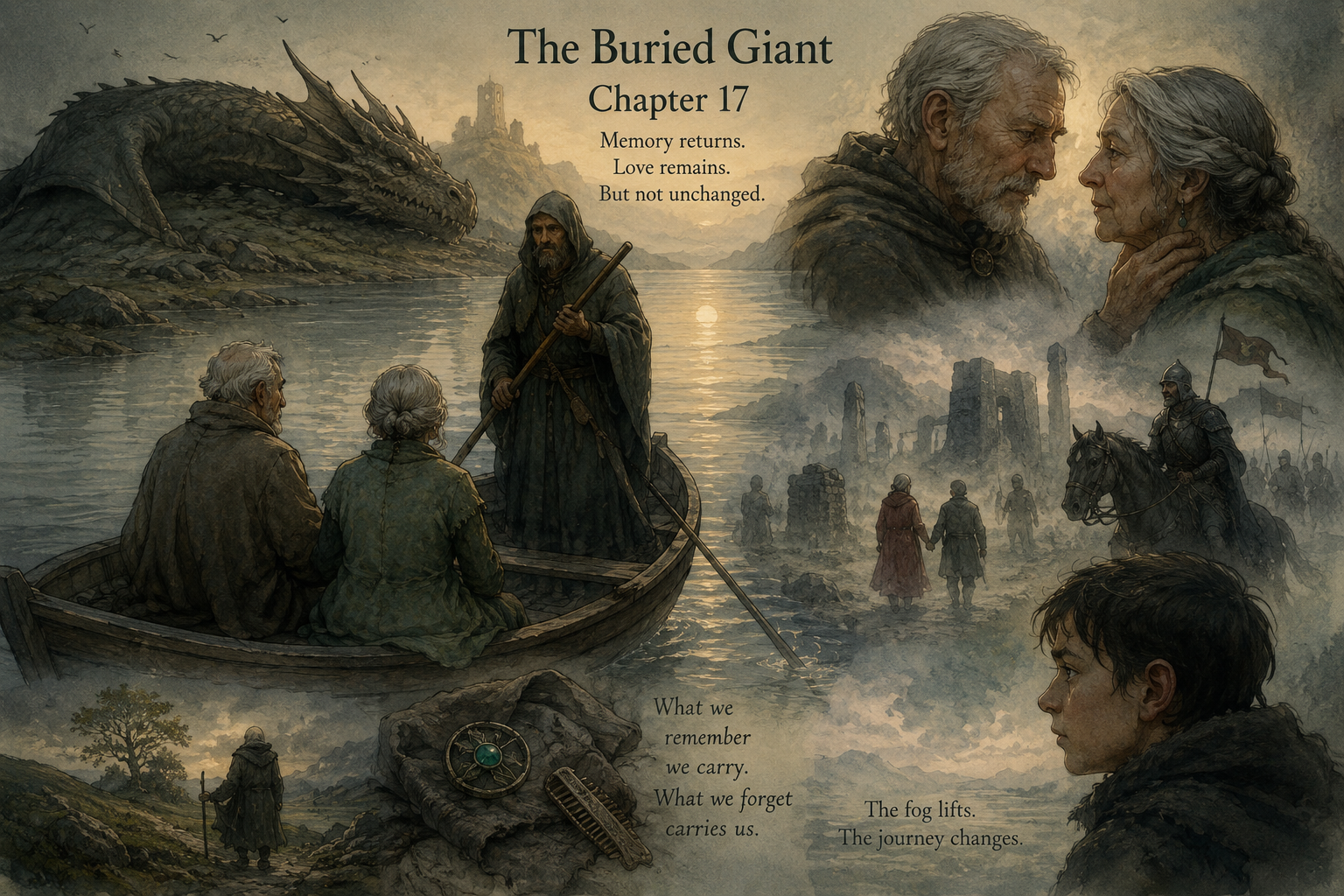
Kazuo Ishiguro – The Buried Giant Chapter Three
Chapter 3 feels like the moment the fog stops being only atmosphere and starts looking suspiciously like political infrastructure. As Wistan and Edwin enter the story, the journey grows larger and darker, revealing a world where forgotten wars and buried fear still quietly shape how people see each other.
Chapter 3 feels like two elderly travellers accidentally walking into the middle of an old geopolitical conflict while still trying to remember why they left home in the first place. The world suddenly becomes larger, harsher, and more structured, as the quiet fog of the earlier chapters gives way to borders, soldiers, suspicion, and buried violence.
What struck me most is how the chapter slowly reveals that the mist has not removed fear or conflict — it has only softened people’s ability to fully remember them. The tension between Saxons and Britons exists everywhere beneath the surface, even when nobody speaks about it directly. Wistan enters the story almost like a force from another reality compared to Axl and Beatrice. He is focused, physically capable, decisive, and completely untouched by the passive drifting that dominates the older couple’s world.
Edwin’s situation also becomes important. He is treated as an outsider because of the strange bite on his body, and the reactions around him reveal how quickly fear turns into social exclusion. The community does not truly understand what happened to him, but uncertainty itself becomes enough to isolate him. Ishiguro is very subtle here: the danger is not only monsters or violence, but how societies behave when they cannot explain something.
The chapter also expands the scale of the novel dramatically. Earlier the story felt almost enclosed inside villages, fog, and fading memories. Now there are hints of old wars, massacres, shifting loyalties, and historical wounds buried beneath the landscape itself. The mist begins to feel less like a natural phenomenon and more like a fragile political solution holding something much darker beneath it.
I also noticed how differently the characters move through the world. Axl still tries to understand people carefully and rationally, Beatrice moves more through emotional intuition, while Wistan acts with purpose as if he already knows exactly where history is heading. Their conversations often seem to happen on different layers simultaneously, which creates a strange feeling that nobody fully shares the same reality anymore.
Reading the chapter slowly creates increasing unease. The story still avoids large dramatic events, yet almost every conversation carries hidden tension underneath it. By the end, the journey no longer feels like a search for a son alone. It begins to feel like movement toward the return of memory, old violence, and truths that entire societies may have chosen to bury beneath the fog for a very long time.