
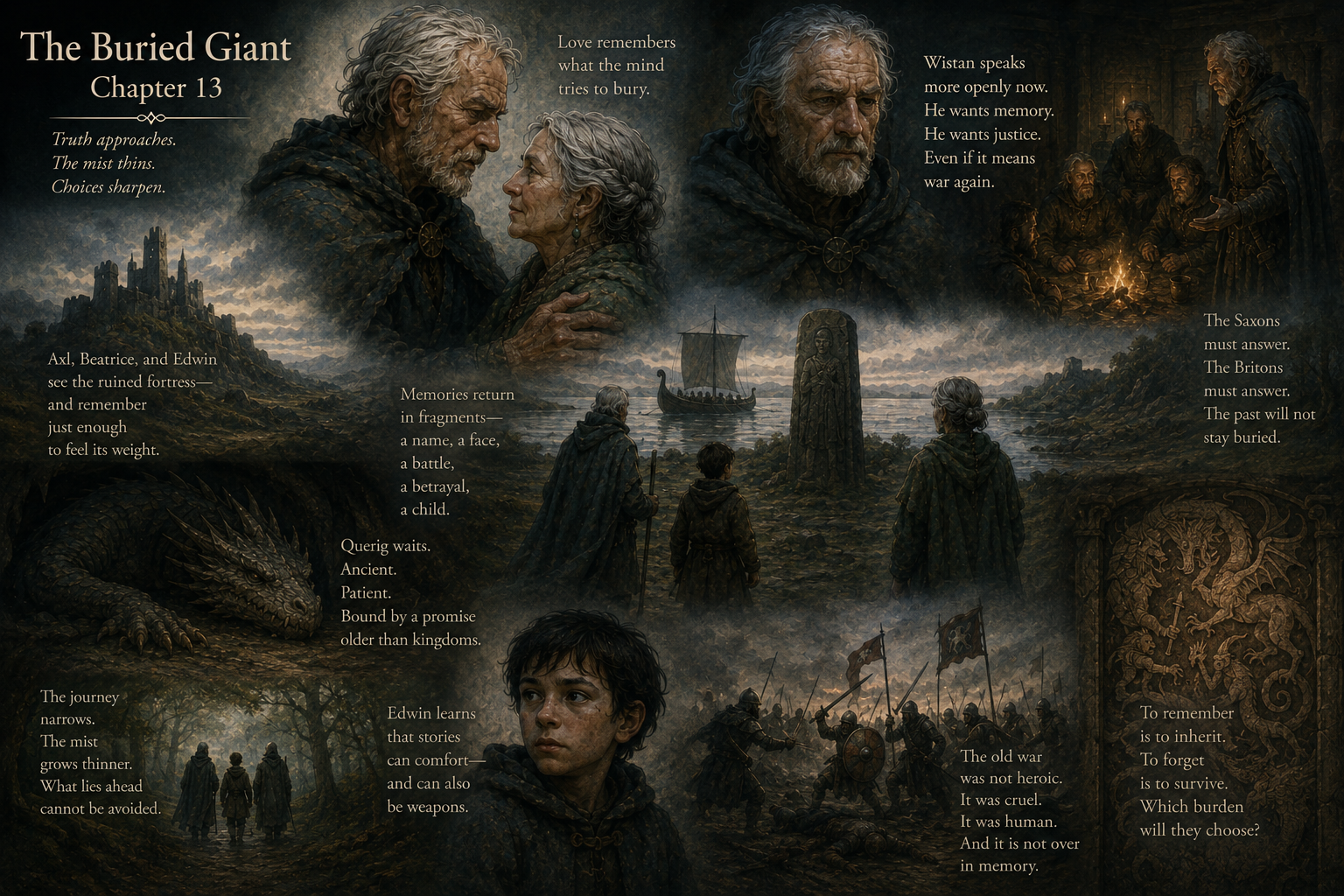
Kazuo Ishiguro – The Buried Giant Chapter Seven.
Chapter 7 feels like the moment the book stops hiding its skeletons — literally. Deep beneath the monastery, buried bones and hidden chambers reveal that the mist may not protect the world from monsters, but from the memory of what humans once did to each other.
Chapter 7 feels like a fantasy dungeon crawl designed by archaeologists, theologians, and people with unresolved national trauma. The story finally moves underground, and beneath the monastery Ishiguro reveals not treasure or heroic glory, but bones, buried violence, and the uncomfortable realization that entire civilizations may have been built on selective memory.
What struck me most is how dramatically the emotional atmosphere changes once the characters descend into the tunnels. Earlier chapters often felt uncertain, foggy, and emotionally muted. Here the uncertainty becomes physical. Darkness, hidden chambers, skulls, giant bones, ancient burial sites, and the constant fear of what may be waiting further below create a pressure that feels almost mythological. Yet even in these moments, Ishiguro avoids simple adventure storytelling. The danger is never only the beast itself — it is what the beast reveals about the world above.
Sir Gawain becomes especially fascinating in this chapter. Until now he has seemed half tragic knight, half wandering relic from another age. But underground, his role grows far more ambiguous. He repeatedly tries to slow the group, discourage deeper exploration, and redirect attention away from the buried horrors below. It increasingly feels as if he already knows much more than he admits, and his loyalty may not be to truth itself, but to preserving the fragile peace built upon forgetting.
Wistan, in contrast, moves with growing certainty. The deeper they descend, the more convinced he becomes that the mist and the dragon are tied to buried crimes from the past. His worldview differs completely from Gawain’s. For Wistan, memory — even painful memory — is necessary. Peace without truth appears to him almost immoral, because it leaves injustice unresolved beneath the surface.
Edwin’s role in the chapter also develops in a subtle but important way. Earlier he often reacted primarily through fear and confusion, but now he begins observing more carefully. The underground journey becomes part of his transformation. The bite on his body still isolates him socially, yet Wistan increasingly treats him like someone capable of facing darkness directly rather than hiding from it.
One of the strongest elements in the chapter is the discovery of the burial chambers and skeletons. These scenes completely reframe the world of the novel. The old wars between Britons and Saxons stop feeling distant or abstract. The bones underground silently confirm that the violence was real, systematic, and enormous in scale. Suddenly the mist no longer appears merely mysterious — it begins to look almost intentional, as if forgetting itself became a political mechanism to prevent endless revenge.
I also noticed how the underground mirrors the psychology of the book itself. Everything buried physically beneath the monastery reflects what has been buried emotionally and historically throughout the story. The characters are not simply walking through tunnels; they are descending into suppressed memory.
Beatrice’s presence adds another emotional layer. Her fear is not heroic fear of monsters, but something more human and intimate. She senses that recovering truth may carry emotional consequences she cannot fully control. Throughout the chapter there is a growing tension between wanting clarity and fearing what clarity may bring.
The conversations between Wistan and Sir Gawain become increasingly important because they now feel less like ordinary disagreement and more like two moral systems confronting one another. Gawain believes forgetting may preserve civilization itself. Wistan believes civilization built upon forgetting eventually rots from beneath.
Reading the chapter slowly creates a strange sensation of descending not only underground, but deeper into the moral core of the novel. The fantasy elements become larger and darker, yet paradoxically the story also becomes more realistic psychologically. It starts feeling less like a myth about dragons and more like an exploration of how societies survive after atrocities — and what they choose to bury in order to continue living together.
By the end of the chapter, the dragon no longer feels like a distant monster waiting somewhere ahead. Querig begins to feel like the center of an entire historical system — a living force connected to memory, peace, violence, guilt, and the terrifying possibility that once the mist fades, the world may remember more than it can peacefully endure.