
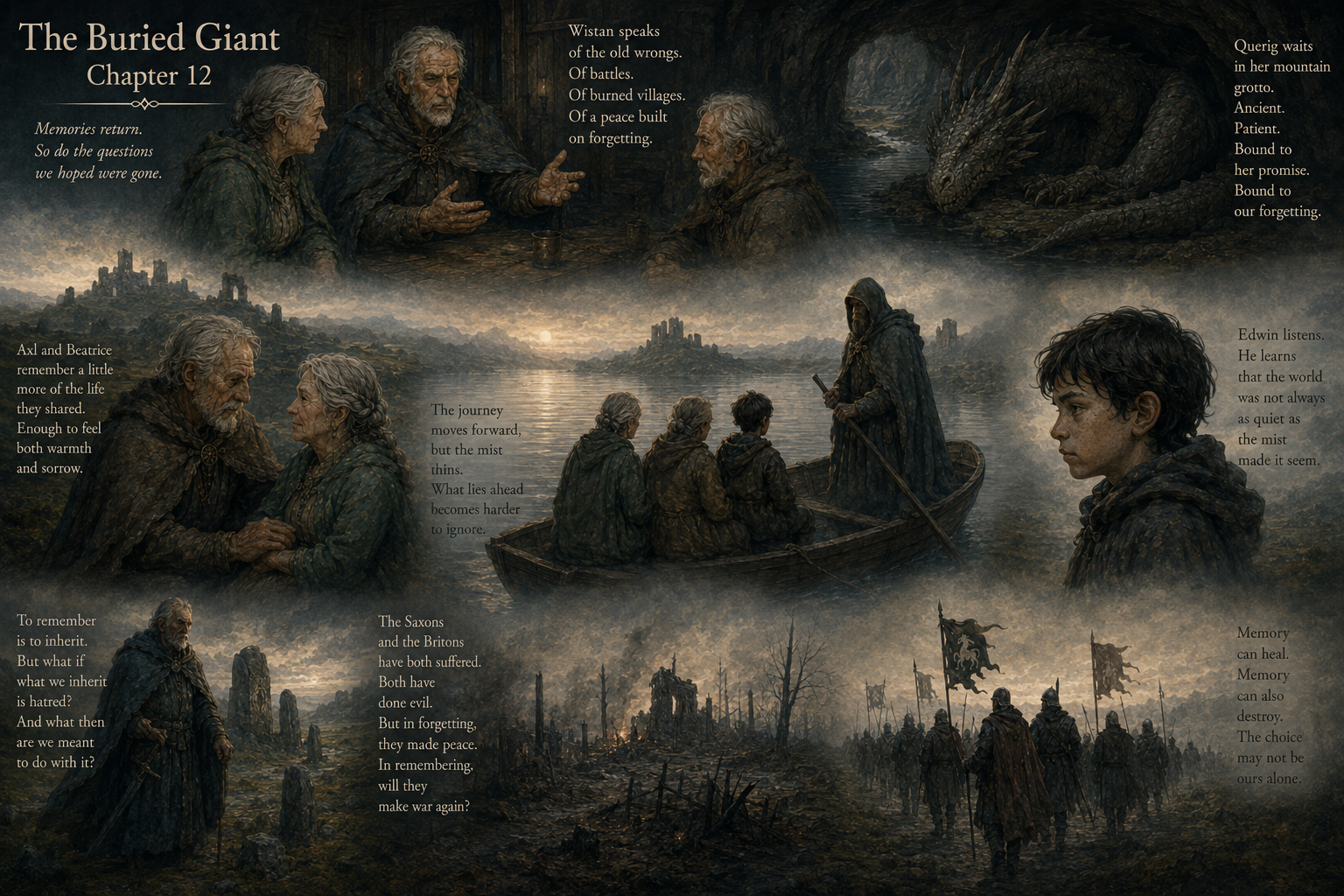
Kazuo Ishiguro – The Buried Giant Chapter 8
Chapter 8 feels like walking through a forest where even the ruins seem to remember things humans tried to bury centuries ago. Beneath the quiet conversations and strange encounters, the chapter carries the feeling that history is slowly waking up again.
Chapter 8 feels like the calm after surviving the underground horrors, except nobody actually leaves unchanged and the forest itself now behaves like it remembers things humans try to forget. The chapter becomes quieter on the surface, but psychologically it may be one of the most unsettling parts of the book so far.
What struck me most is how strongly the story shifts into Edwin’s perspective. Earlier he often felt like someone carried along by older, stronger people and larger events. Here he begins experiencing the world more independently, and the line between reality, memory, fear, dream, and intuition becomes increasingly blurred. The strange girl he encounters in the forest feels less like a normal meeting and more like the novel itself speaking through symbols and half-buried fears.
The girl is fascinating because Ishiguro never fully explains her role. She appears wounded, isolated, almost outside ordinary human society, yet she also speaks with an eerie calmness that makes her feel connected to something older and deeper than the immediate events around Edwin. Their interaction carries a strange emotional tension: innocence mixed with danger, compassion mixed with fear. Edwin wants to help her, but also senses that approaching her may pull him further away from the world he previously understood.
What I found especially interesting is how the chapter explores the idea that violence leaves traces not only in memory, but in landscapes themselves. Wistan’s observations about the tower, the moat, and the old defensive structures transform the ruins into historical evidence. The environment stops being passive scenery. The land itself becomes a kind of archive of forgotten wars and massacres.
Wistan’s role here grows even more complex. He no longer appears only as warrior or protector, but almost as historian and strategist combined. When he explains how the fortress once functioned during battle, the past suddenly becomes vivid and horrifying. He sees patterns everywhere — tactical structures, buried intentions, historical cycles — and through him the reader begins understanding that the peace between Britons and Saxons may rest upon layers of violence that were never truly resolved.
Edwin listens carefully to these explanations, and this is important because his transformation increasingly happens through observation rather than action. Wistan is teaching him how to see history hidden beneath surfaces. Earlier Edwin mainly feared monsters and exclusion. Now he begins recognizing how entire societies can become shaped by fear, war, and inherited hatred.
The monastery storyline also reveals something crucial: even religious institutions are deeply entangled in politics, survival, and secrecy. The monks speak about peace and morality, yet their actions often reveal fear, compromise, and hidden agendas. Nobody in the novel seems fully innocent anymore. Even kindness often carries desperation beneath it.
One of the strongest emotional elements in the chapter is the growing sense that Edwin stands between multiple possible futures. The mysterious girl represents one path — isolation, fear, perhaps something connected to the darker mythic forces of the world. Wistan represents another — discipline, purpose, and confrontation with truth, however painful. Edwin himself has not yet chosen what kind of person he will become.
The atmosphere throughout the chapter remains strangely restrained. There are no massive battles or dramatic revelations, yet almost every scene feels loaded with hidden significance. Birds, streams, ruined towers, traps, bones, and quiet conversations all seem connected to something larger slowly emerging beneath the surface of the narrative.
Reading the chapter slowly creates the sensation that the story is holding its breath before something inevitable arrives. The novel no longer feels like wandering through mystery alone. It increasingly feels like approaching the point where buried memory, historical guilt, and personal identity will collide.
By the end of the chapter, the mist itself seems less like protection and more like delay — a temporary silence before truths too large and painful to remain buried any longer begin returning to the world.