
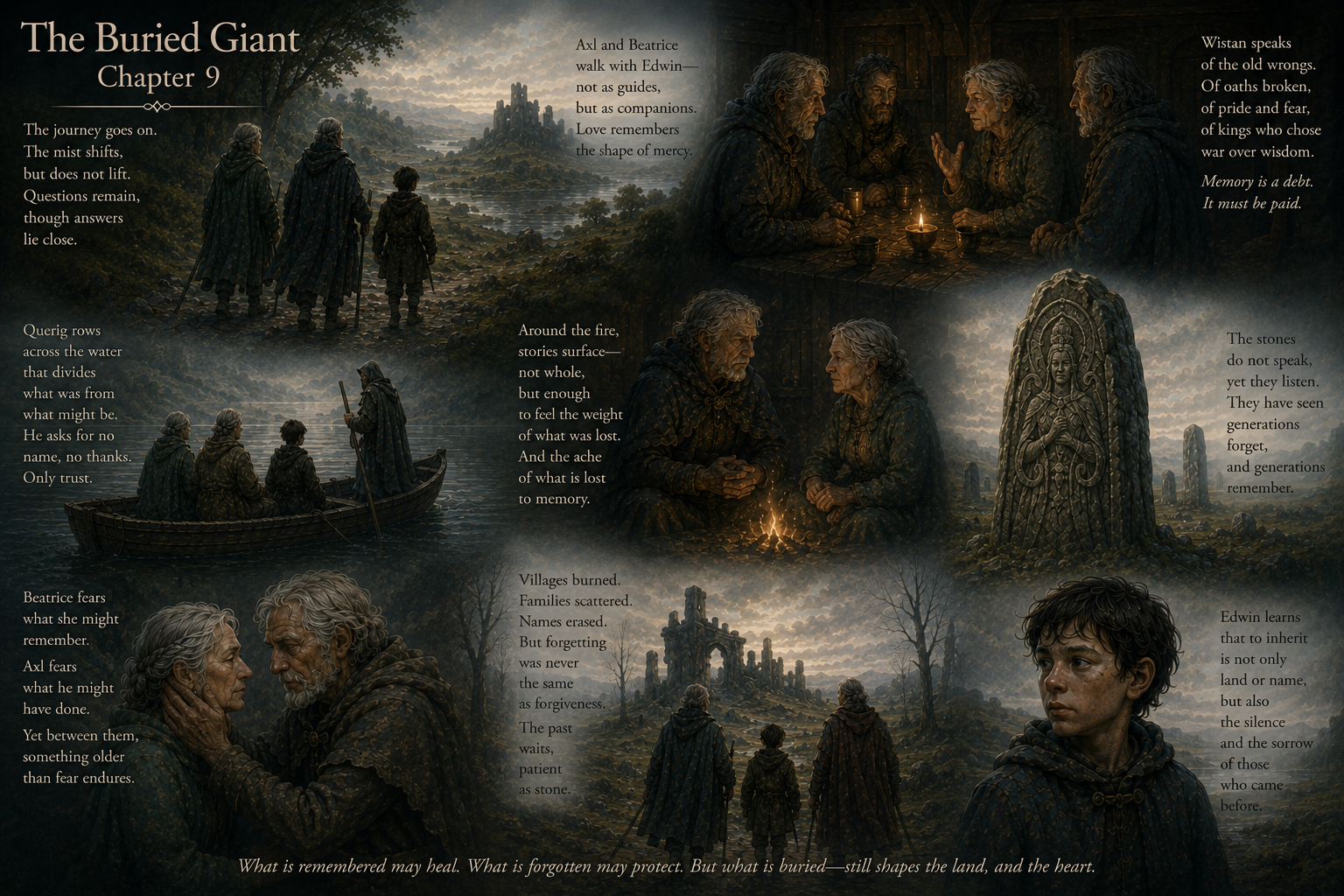
Kazuo Ishiguro – The Buried Giant Chapter 10.
Chapter 10 feels like the moment Edwin realizes growing up may mostly involve disappointing people you admire while pretending everything is still fine around the campfire. Beneath the quiet conversations with Wistan, the chapter becomes a story about loyalty, inherited hatred, and the painful birth of independent thinking.
Chapter 10 feels like a medieval mentorship session where Edwin accidentally discovers that becoming an adult may require lying to both your enemies and the people you admire most. After the philosophical heaviness of Gawain’s reflections, the story narrows inward again and becomes deeply personal, focusing on loyalty, identity, fear, and the painful beginning of independence.
What struck me most is how much Edwin changes in this chapter. Earlier he mostly reacted to events around him, but here he actively makes choices. Small choices perhaps, but morally important ones. For the first time he deliberately withholds truth from Wistan, not because he wishes harm, but because he fears losing something emotionally important to him. That makes the chapter feel less like fantasy adventure and more like the beginning of adulthood.
The relationship between Edwin and Wistan becomes the emotional center of the chapter. Wistan genuinely believes he is shaping Edwin into a future warrior, someone strong enough to survive what is coming after the mist fades. He treats Edwin with seriousness and respect, offering him guidance, discipline, and purpose. Yet at the same time Edwin increasingly realizes that following Wistan completely may also mean inheriting his hatred, his mission, and perhaps his future violence.
One of the most fascinating aspects of the chapter is the recurring presence of Edwin’s mother’s voice. Ishiguro leaves it ambiguous whether this is memory, intuition, fever, fear, or something almost supernatural. The voice becomes a symbol of another possible identity for Edwin — a pull toward childhood, safety, emotional truth, and personal attachment rather than duty and conflict.
Edwin’s deception is psychologically very believable. He admires Wistan deeply and wants his approval, yet simultaneously fears what Wistan may do if certain truths are revealed. That creates a very human tension: the painful realization that loyalty to one person may require betraying another. Ishiguro handles this with enormous subtlety. There are no dramatic speeches or emotional breakdowns. The conflict exists almost entirely inside Edwin’s thoughts.
Wistan himself becomes more morally complex in this chapter. Earlier he often seemed almost unquestionably noble compared to figures like Gawain or the fearful monks. Here we see more clearly that his worldview is built not only on courage and truth, but also on deep inherited anger. His memories of Saxon humiliation under Briton rule reveal why the return of memory matters so much to him personally. He does not simply seek justice in the abstract. He carries generational wounds.
What fascinated me most is how the chapter reframes hatred. Wistan speaks openly about old humiliations, dead companions, ethnic division, and historical resentment. Yet he also remembers friendship, shared training, and human closeness across enemy lines. The novel refuses to reduce either Saxons or Britons into simple moral categories. Instead it shows how historical violence corrupts ordinary human relationships over generations.
The atmosphere throughout the chapter remains restrained but emotionally tense. There are no huge battles or revelations, yet every conversation between Edwin and Wistan carries hidden pressure beneath it. Edwin wants to become stronger and worthy in Wistan’s eyes, but he increasingly senses that becoming the man Wistan wants him to become may also cost him part of himself.
Reading the chapter slowly creates a strange emotional effect. The fantasy setting almost disappears into the background, while questions about mentorship, inherited hatred, loyalty, and moral independence move into focus. Edwin no longer feels like a child wandering through someone else’s story. He begins to feel like a person standing at the edge of defining his own moral identity.
By the end of the chapter, the mist still covers the land, but inside Edwin something has already started clearing. He now understands that truth is dangerous not only because enemies may discover it, but because it forces people to choose who they truly are loyal to when different loyalties can no longer coexist peacefully.