
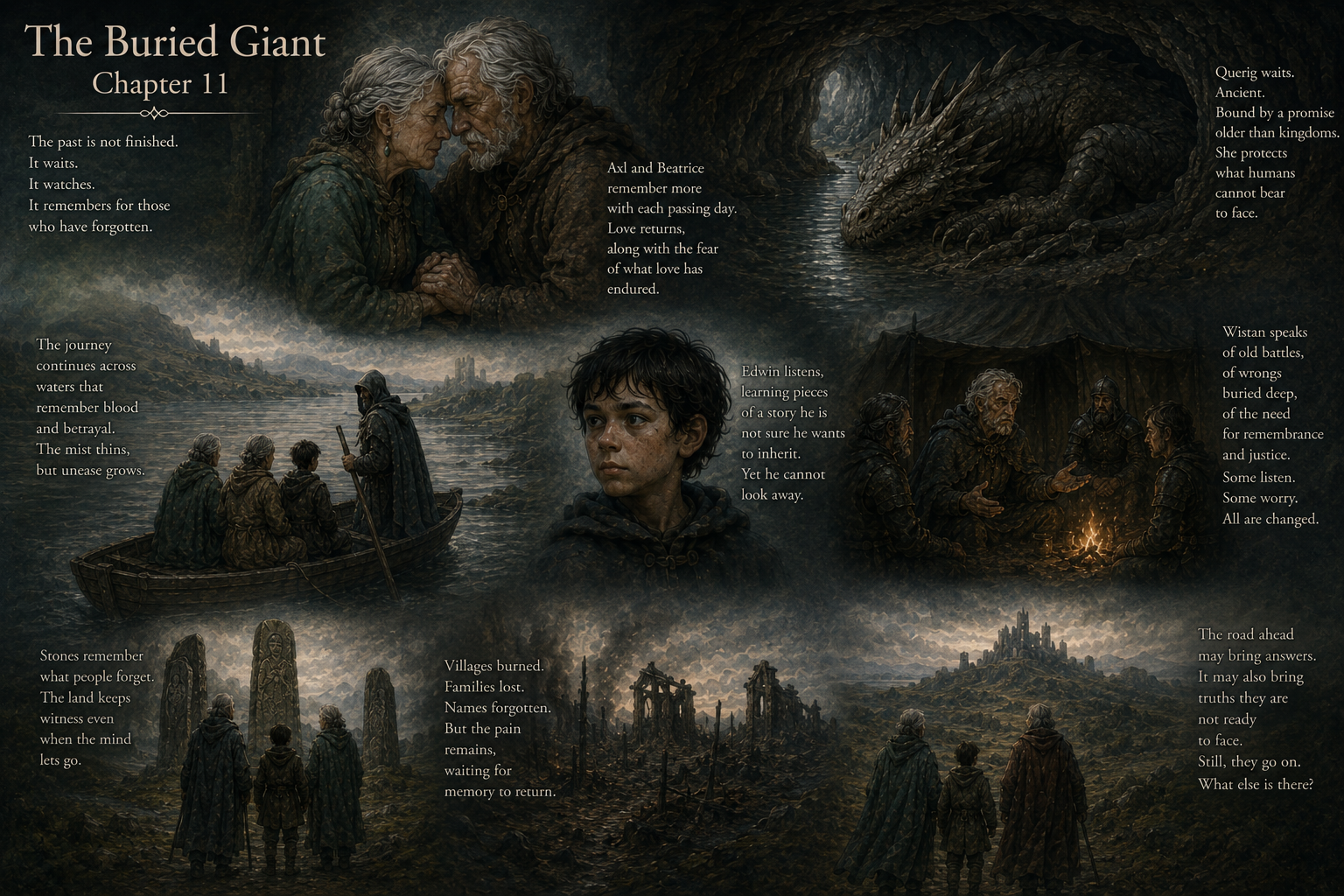
Kazuo Ishiguro – The Buried Giant Chapter 9.
Chapter 9 feels like an old knight slowly realizing that protecting peace and protecting truth may no longer be the same thing. Through Gawain’s wandering thoughts and guilty memories, the book turns from mystery into quiet moral tragedy.
Chapter 9 feels like Sir Gawain accidentally wandering into his own conscience while trying to convince himself he’s still just following orders. For the first time the novel steps fully inside his mind, and beneath the old knight’s politeness, fading memories, and strange dignity, we begin seeing the enormous moral weight he has been carrying all along.
What struck me most is how deeply melancholic the chapter feels. Earlier chapters often carried uncertainty, fear, or philosophical tension, but here the emotional tone becomes almost mournful. Gawain is no longer simply a mysterious knight protecting the dragon. He begins to look like a man trapped between loyalty, guilt, duty, and the realization that peace itself may have required terrible sacrifices.
The women on the hills are especially fascinating because Ishiguro never fully explains whether they are symbolic, supernatural, memory fragments, or real people carrying inherited grief. Their voices follow Gawain almost like accusations from history itself. They repeatedly challenge him with questions about Querig, Arthur, old massacres, and forgotten crimes. It feels less like ordinary conversation and more like memory trying to force itself back into consciousness.
What becomes increasingly clear is that Gawain’s mission is not heroic in the traditional fantasy sense. He is not hunting evil to restore justice. In many ways he is trying to delay the return of something terrible. His loyalty to Arthur now feels tragic because he slowly realizes that the peace Arthur created may have depended on silence, suppression, and collective forgetting.
The chapter also reframes Wistan in an important way. Earlier he appeared almost unquestionably noble compared to the exhausted old knight. But through Gawain’s reflections, we begin understanding why Wistan frightens him so deeply. Wistan does not merely want truth. He may also bring vengeance, renewed war, and historical fury back into the world once the mist disappears.
One of the most powerful themes in the chapter is the conflict between justice and peace. Gawain understands that terrible crimes happened to Saxons under Arthur’s reign. Yet he fears that remembering these crimes fully may restart endless cycles of violence. The women mocking him from the hills almost represent the opposite force — the belief that forgetting injustice is itself immoral.
I also noticed how physically tired and fragile Gawain constantly feels. His aging body mirrors the exhaustion of the entire political system he protects. He clings to duty because without it he may have to confront what his life has truly served. That makes him one of the most tragic figures in the novel. He is neither fully right nor fully wrong.
The atmosphere throughout the chapter is strangely dreamlike. The landscape, the hills, the women, the shifting weather, and Gawain’s wandering thoughts blend together into something that feels almost outside normal time. Memory, guilt, myth, and reality overlap constantly. Ishiguro makes the reader experience confusion not as chaos, but as emotional erosion.
What fascinated me most is how the chapter quietly changes the reader’s moral orientation. Earlier it was easy to view the mist simply as deception that must be destroyed. After spending time inside Gawain’s perspective, the situation becomes much more complicated. The mist may be false and dangerous, but removing it may also unleash hatred powerful enough to destroy what little peace remains.
By the end of the chapter, Gawain no longer feels like an obstacle standing in the way of the story. He feels like the last exhausted guardian of a deeply flawed peace system, fully aware that once Querig dies, history itself may wake up hungry again.