
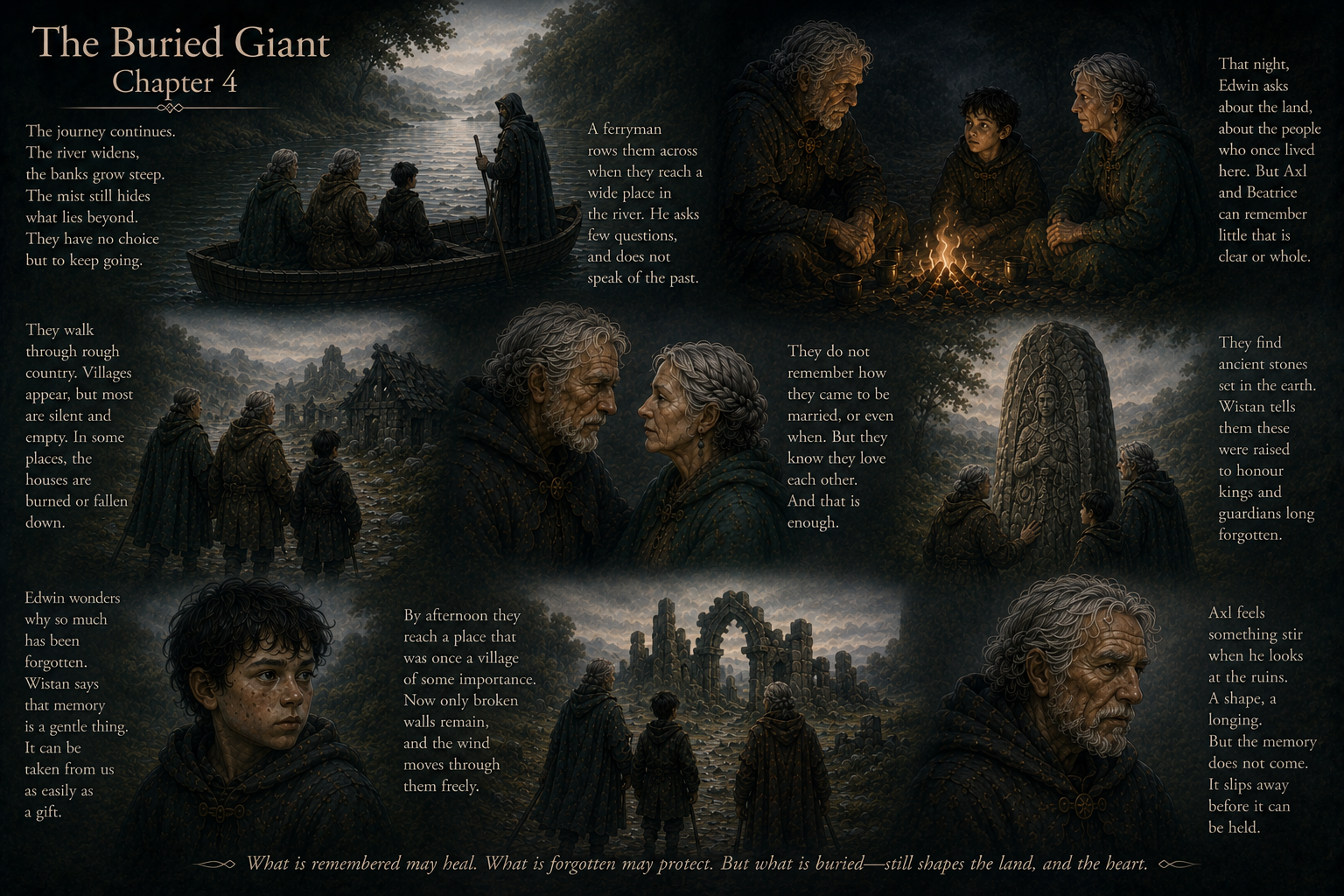
Kazuo Ishiguro – The Buried Giant Chapter 12
Chapter 12 feels like the moment Edwin realizes memory is not a treasure chest but a loaded weapon everyone wants him to carry for different reasons. As old truths return beside the frozen pond, the real danger no longer seems to be ogres or dragons, but what hatred does once it finally remembers its own name.
Chapter 12 feels like a mountain hike guided by a warrior, a fog, unresolved childhood trauma, and several increasingly suspicious ogres sitting around a frozen pond looking emotionally exhausted. Beneath the fantasy surface, the chapter becomes deeply psychological, as Edwin is finally forced to confront memory, identity, and the possibility that the stories shaping his life may not mean what he believed.
What struck me most is how differently memory behaves in this chapter compared to earlier parts of the novel. Previously memories returned slowly, fragmentarily, almost like distant echoes through fog. Here they arrive with emotional force. Edwin suddenly begins remembering his mother, his childhood, and the violence surrounding her disappearance. The past stops feeling abstract and becomes painfully personal.
The relationship between Edwin and Wistan reaches a crucial turning point. Until now Edwin has largely admired Wistan as protector, mentor, and source of strength. But the further they climb toward Querig’s territory, the more Edwin begins sensing that Wistan’s mission is driven not only by justice, but also by inherited hatred and old wounds. For the first time Edwin openly questions whether truth alone is enough if truth only leads to endless vengeance.
Wistan’s handling of Edwin throughout the chapter is fascinating because he constantly moves between tenderness and manipulation. He genuinely respects the boy and wants to make him strong, yet he also tries to shape Edwin’s emotions toward a specific future — one built upon loyalty to Saxons and anger toward Britons. The mentorship now feels morally complicated rather than heroic.
One of the strongest scenes in the chapter is Edwin’s encounter with the ogres near the frozen pond. Ishiguro deliberately avoids turning them into simple monsters. Instead they appear strangely melancholic, almost broken, sitting together in silence like remnants of something ancient and forgotten. Edwin’s pity toward them becomes important because it reveals that he still instinctively sees suffering before ideology.
The ogres themselves feel symbolic. Earlier in the novel monsters often represented vague fear or mythic danger. Here the creatures seem almost tragic — beings trapped in a landscape poisoned by old violence, memory loss, and fear. Edwin senses something wounded in them, and his reaction sharply contrasts with Wistan’s more practical warrior perspective.
What fascinated me most is the confession scene beneath the trees. Edwin finally admits that he deceived Wistan and remembers more than he previously revealed about his mother and the attack on his village. This moment quietly transforms Edwin from follower into moral participant. He is no longer simply absorbing the values of older men around him. He begins trying to decide for himself what justice should mean.
Wistan’s response is also incredibly important. He does not react with simple anger. Instead he reframes Edwin’s memories politically and historically, explaining how Britons once slaughtered Saxons under Arthur’s rule. For Wistan, personal suffering and national suffering are inseparable. The chapter therefore deepens one of the novel’s central moral questions: can historical violence ever remain personal, or does it inevitably become collective hatred across generations?
The atmosphere throughout the chapter is tense yet strangely reflective. The mountain landscape, frozen water, wind, trees, and silence create the feeling of standing near the edge of revelation. Querig herself still remains mostly absent physically, yet everything in the chapter points toward her presence. The dragon increasingly feels less like a creature and more like the center of a system holding memory and violence in suspension.
Reading the chapter slowly creates a growing sense that innocence is disappearing from the story. Edwin’s memories return alongside political reality, and he realizes that no version of the past is morally clean. Britons committed atrocities. Saxons suffered. Revenge breeds revenge. The mist may have hidden truth, but it also prevented inherited hatred from fully consuming another generation.
By the end of the chapter, Edwin stands emotionally between two futures. One path leads toward Wistan’s worldview — memory, justice, identity, and possibly vengeance. The other path remains uncertain, shaped more by compassion, ambiguity, and resistance to inherited hatred. For the first time, the novel suggests that the real battle may not be against the dragon at all, but against what people choose to become once memory returns.