
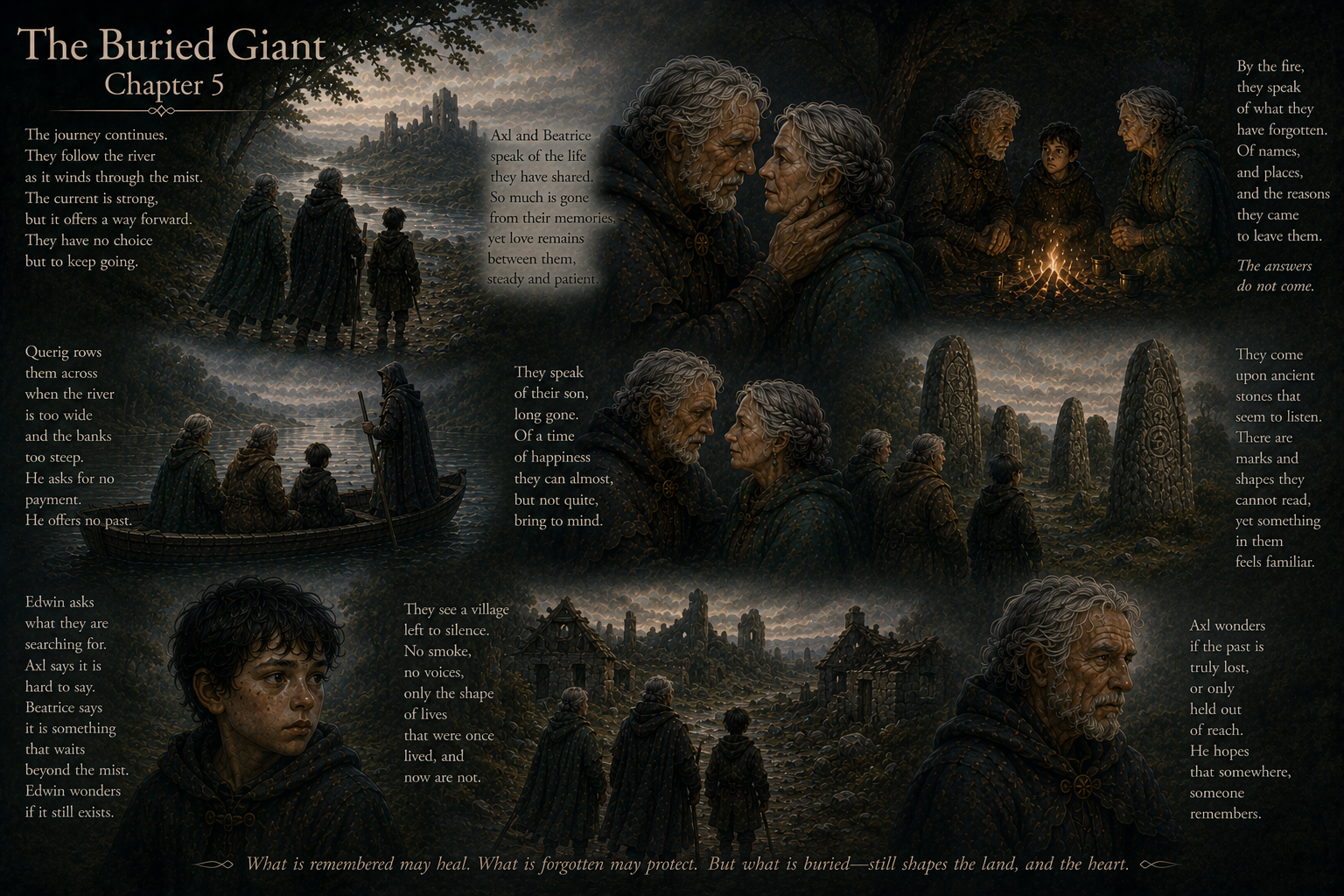
Kazuo Ishiguro – The Buried Giant Chapter 13.
Chapter 13 feels like a fairy tale where even the helpful children quietly carry survival strategies involving poisoned goats and hidden ogres. The closer Axl and Beatrice move toward Querig, the clearer it becomes that memory may heal truth while simultaneously destroying the fragile peace people built around forgetting.
Chapter 13 feels like a mountain trek where even the goats are giving suspicious moral guidance and every small shelter may secretly contain either kindness, trauma, or an ogre slowly digesting bad decisions. Beneath the strange fairy-tale atmosphere, the chapter becomes one of the clearest explorations so far of how memory, fear, and compassion constantly fight inside ordinary people.
What struck me most is how the chapter balances warmth and dread almost simultaneously. Axl and Beatrice spend much of it simply trying to survive cold, exhaustion, and the dangerous mountain terrain. On the surface, very little dramatic happens for long stretches. Yet emotionally, the chapter feels heavy with questions about what should be remembered, what should be forgiven, and whether recovering truth will actually heal anyone.
The children in the mountain shelter are especially fascinating because they initially appear almost like figures from folklore — isolated, strangely polite, suspiciously self-sufficient, living high in the mountains beside a mysterious ditch. Ishiguro creates uncertainty immediately. Axl and Beatrice constantly wonder whether the children are innocent, dangerous, deceptive, or simply shaped by the brutal realities around them.
The dead goat scene becomes one of the most memorable symbolic moments in the novel. At first it seems almost absurdly grotesque: an ogre hidden beneath the remains of the animal, poisoned slowly by the children. Yet Ishiguro refuses to turn the situation into simple horror. The children are not cruel for pleasure. They are frightened, desperate, and trying to survive in a world where adults, soldiers, ogres, and dragons all exist beyond their control.
What fascinated me most is how the chapter constantly shifts moral perspective. The ogre itself is terrifying, yet also pitiful. The children are vulnerable, yet capable of calculated violence. Axl feels compassion even toward the suffering creature beneath the goat, while Beatrice worries more instinctively about danger and survival. Nobody in the chapter exists comfortably inside simple moral categories.
The children’s explanation about poisoning goats for Querig also changes the emotional texture of the novel. Earlier the dragon often felt distant and symbolic. Here Querig suddenly becomes part of ordinary survival routines. Entire communities adapt their behavior around the existence of the she-dragon, almost the way people adapt around weather, war, or famine. That normalization makes the world feel far more realistic and unsettling.
Beatrice’s conversations with Axl throughout the chapter are emotionally central. Their relationship now moves constantly between tenderness and quiet fear. The closer they come to Querig and the possible return of memory, the more openly they discuss whether forgotten truths may destroy the love they still hold onto. One of the most painful ideas in the chapter is that forgetting may sometimes protect relationships more effectively than honesty.
Axl himself becomes increasingly thoughtful and conflicted. He wants to remain morally kind and emotionally loyal, yet he senses that the world around him is built from compromises no decent person can fully accept. The chapter repeatedly places him between competing forms of compassion: compassion for frightened children, for suffering creatures, for Beatrice, and even for people whose past actions may have been terrible.
The mountain setting also matters enormously. The cold wind, cliffs, stones, fog, narrow paths, and distant valleys create the sensation that the characters are climbing not only toward Querig physically, but toward moral exposure. There is less shelter now, less comfort, and fewer illusions available.
One of the strongest underlying themes in the chapter is inherited fear. The children fear ogres. Wistan fears forgotten injustice. Gawain fears returning war. Axl and Beatrice fear memory itself. Everyone in the novel now seems shaped by something old that still moves beneath the surface of daily life.
Reading the chapter slowly creates the feeling that the story has entered its final emotional ascent. The wandering atmosphere of the early chapters is mostly gone. Every conversation now circles around memory, consequence, forgiveness, and survival.
By the end of the chapter, Querig remains physically distant, yet psychologically she dominates everything. The dragon no longer feels merely like a monster waiting in a cave. She has become the fragile center holding together peace, forgetting, love, guilt, and the dangerous possibility that once memory fully returns, nobody will remain emotionally unchanged.