
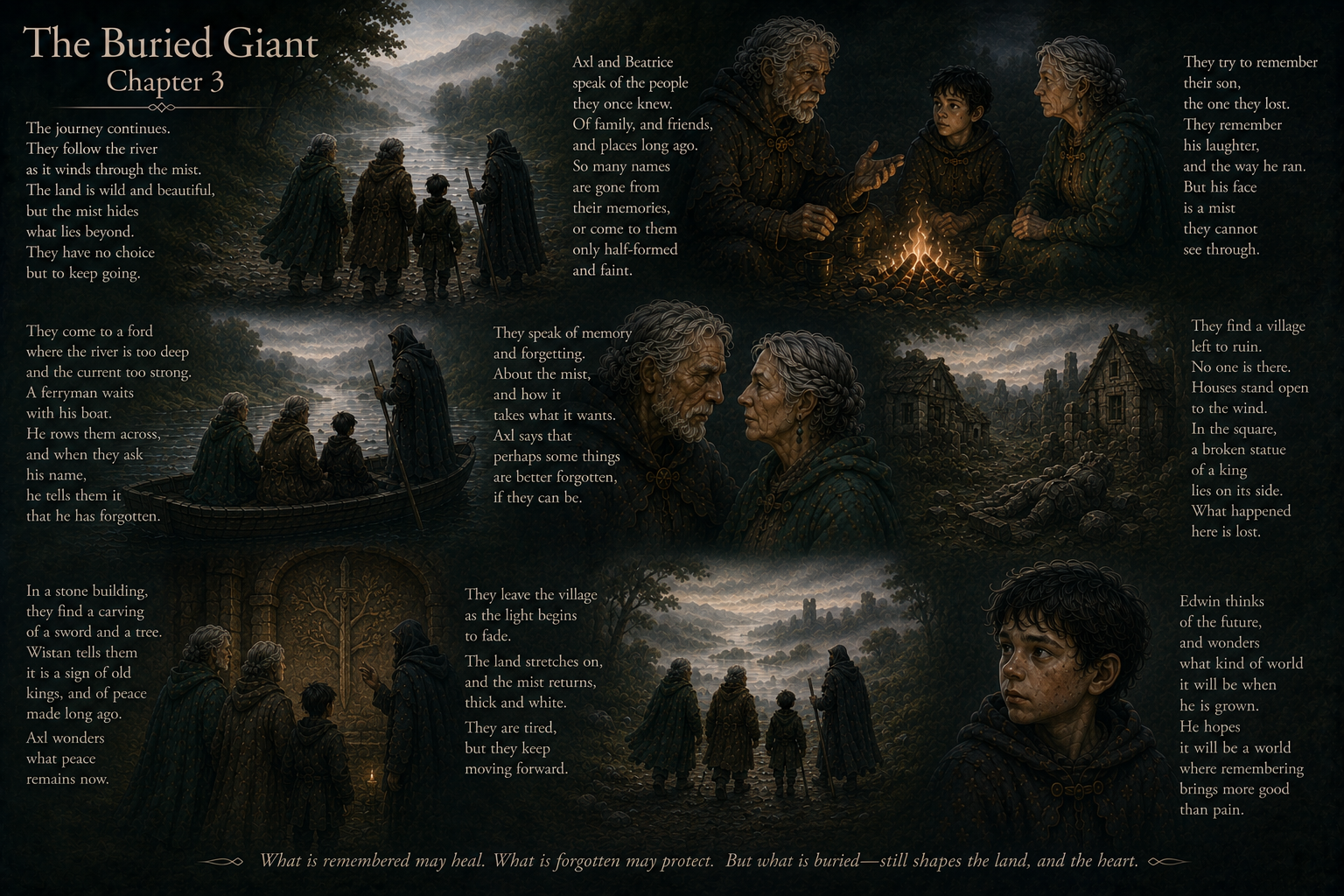
Kazuo Ishiguro – The Buried Giant Chapter 16.
Chapter 16 feels like the moment Edwin understands that memory does not simply return as truth — it returns as inheritance, asking what kind of person he now wants to become. Between Wistan’s call for vengeance and Axl and Beatrice’s quiet kindness, the chapter turns into a crossroads between hatred and humanity.
Chapter 16 feels like the moment Edwin realizes history is no longer an abstract story told by older men beside campfires, but something that has already reached directly into his own life and taken people from him. After the philosophical battles of the previous chapters, the novel suddenly becomes painfully personal again.
What struck me most is how emotionally exposed Edwin feels throughout the chapter. Earlier he still balanced between confusion, admiration, fear, and uncertainty. Here the return of memory lands with much greater force. His mother is no longer just a vague absence shaped by fog and fragmented recollection. He now understands more clearly that she was taken during real violence connected to the same historical conflict Wistan has been describing all along.
The chapter is short, but emotionally important because Edwin’s moral position continues changing. Earlier he feared monsters, then admired Wistan, then questioned him. Now he begins understanding the true cost of inherited hatred. The revenge Wistan speaks about is no longer theoretical. It now connects directly to Edwin’s own pain and family history.
Wistan himself remains complicated. He still acts as protector and mentor, and Edwin clearly longs for his approval. Yet the chapter quietly shows how dangerous Wistan’s worldview may become once memory fully returns. He wants Edwin to carry hatred forward as duty, almost as inheritance. The line between justice and becoming consumed by revenge grows thinner with every chapter.
I also found the appearance of Axl and Beatrice deeply moving here. Compared to Wistan’s intensity, they almost represent another possible way of responding to suffering — gentleness without ideology. Even though they themselves carry fears about memory and the past, their instinct toward Edwin is comfort rather than recruitment into conflict.
One of the strongest moments is when the old couple tell Edwin to remember them in the future. It feels small and quiet on the surface, yet emotionally it becomes enormous because the novel increasingly asks what kind of memories are worth carrying forward. Hatred? Loyalty? Love? Grief? Compassion? Edwin stands exactly at that crossroads.
The mountain landscape also continues reflecting the emotional state of the story. The cold wind, exhaustion, steep paths, and disappearing figures create the feeling that everyone is slowly separating into different destinies. The closer they come to Querig, the harder it becomes for the characters to continue traveling together emotionally, even when they still share the same physical road.
What fascinated me most is the strange mix of hope and sadness in Edwin by the end of the chapter. He finally possesses more truth about his mother and his past, yet the truth itself immediately pushes him toward difficult choices. The return of memory does not heal him instantly. It burdens him with responsibility.
Reading the chapter slowly creates the feeling that innocence has almost completely disappeared from the novel now. The wandering uncertainty of the early chapters has transformed into something sharper and heavier. Every recovered memory now carries consequence.
By the end of the chapter, Edwin no longer feels like a child simply following older people through fog and ruins. He begins to look like someone standing at the edge of becoming either a future bridge between worlds — or another carrier of the same ancient hatred the mist once kept asleep.