
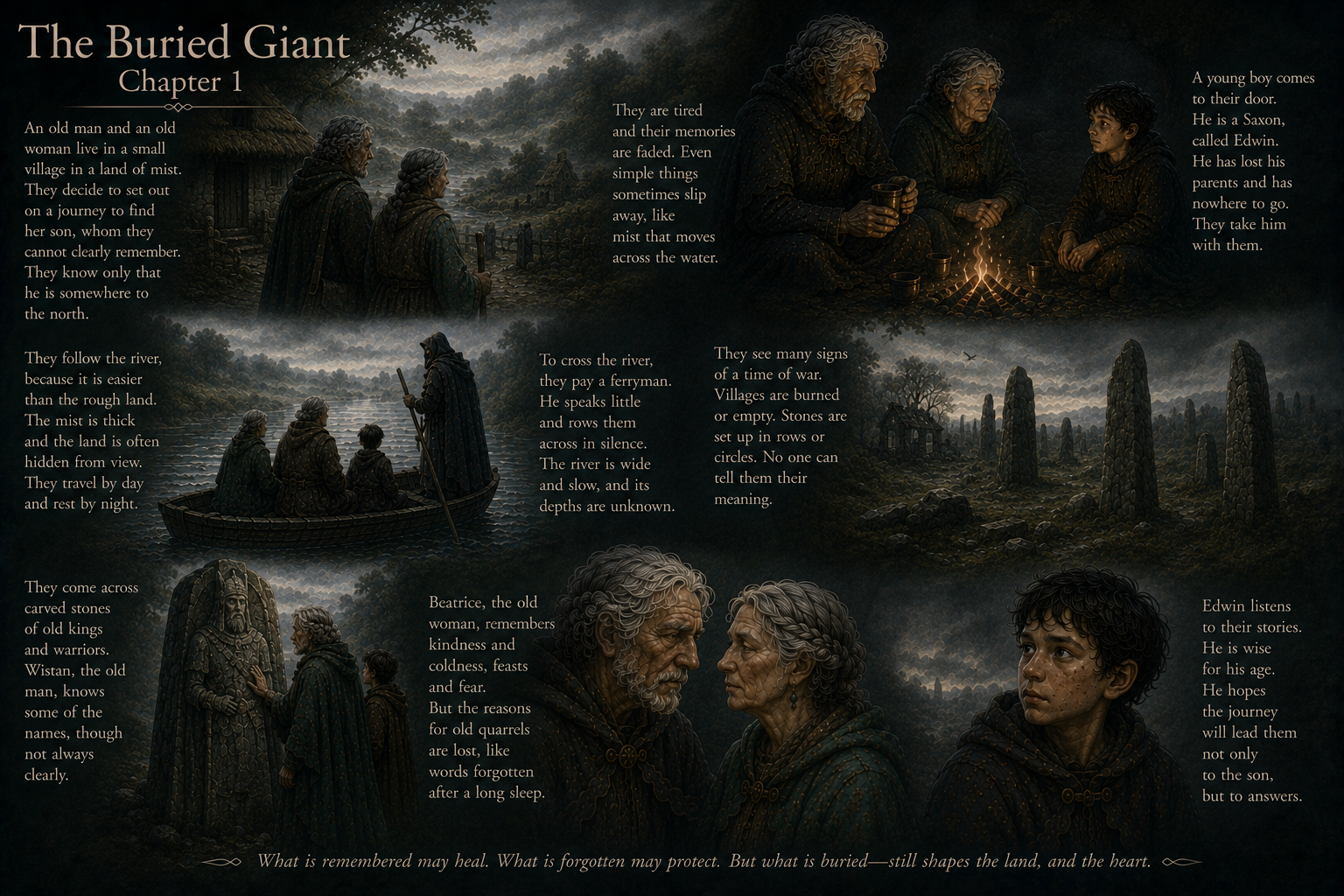
Kazuo Ishiguro – The Buried Giant Chapter 17.
Chapter 17 feels like the moment the fog finally lifts and everyone realizes memory is far less romantic than philosophers and old warriors promised around campfires. As Axl and Beatrice face the boatman and the return of buried truths, the novel quietly reveals that love can survive many things — but not always the full weight of remembered time.
Chapter 17 feels like the entire novel finally arriving at the emotional shoreline it has been rowing toward since page one, except nobody is fully prepared for what memory actually costs once the mist begins to disappear. The chapter is quiet on the surface, almost gentle at times, yet emotionally it may be the most devastating part of the entire book.
What struck me most is how completely the atmosphere changes after Querig’s death. Earlier chapters were filled with tension, uncertainty, hidden violence, and philosophical conflict about whether memory should return at all. Now the answer slowly begins unfolding in real time. Memories rise not triumphantly, but painfully. The return of truth feels less like liberation and more like waking after a long anesthesia into grief, regret, love, guilt, and irreversible knowledge.
The boatman sequence becomes the emotional and symbolic center of the entire novel. Throughout the story the ferryman myth lingered quietly in the background, almost like folklore. Here it transforms into reality. The crossing is no longer abstract symbolism. It becomes the final test of love itself.
Axl and Beatrice’s conversations with the boatman are heartbreaking precisely because they remain so restrained. Nobody cries dramatically. Nobody delivers grand speeches. Instead the pain exists in hesitation, unfinished sentences, careful politeness, and the terrifying possibility that two people may deeply love one another and still not be allowed to continue together once full memory returns.
What fascinated me most is how the novel now reframes forgetting completely. Earlier the mist appeared morally ambiguous but emotionally protective. Now we understand just how much Axl and Beatrice’s love depended on selective forgetting. As memories return, old betrayals, absences, disappointments, and wounds re-emerge beside tenderness and devotion. Love survives, but innocence does not.
The boatman himself is one of the most powerful symbolic figures in the novel because he behaves neither cruelly nor kindly. He simply performs a function older than the characters themselves. His questions about Axl and Beatrice’s relationship are almost unbearably painful because they force the couple to confront whether their bond remains strong once memory becomes complete rather than partial.
One of the deepest emotional themes in the chapter is timing. Again and again the novel suggests that love is not destroyed by one terrible event alone, but by accumulated distance, silences, wounds, and moments left unresolved over years. The mist delayed these truths, but could never erase them permanently.
Axl’s desperation becomes especially moving because he increasingly understands what is happening before Beatrice fully does. He senses that the return of memory may separate them emotionally even before physical separation occurs. Yet he still continues gently caring for her, helping her, comforting her, and trying to preserve dignity in a situation he cannot control.
Beatrice, meanwhile, remains emotionally complex until the very end. Her love for Axl is genuine, deep, and tender, yet recovered memories quietly alter the emotional landscape beneath that love. Ishiguro refuses simplistic romantic resolution. Instead he presents something far more human and painful: two people can truly love each other and still carry wounds too old and deep to disappear completely.
The rain, shorelines, caves, islands, waves, and evening light throughout the chapter create an almost mythological stillness. The fantasy elements largely fade away, leaving something closer to emotional allegory. Dragons, warriors, and ancient wars become background echoes beside the intimate tragedy unfolding between two elderly people trying desperately to remain close while memory itself pulls them apart.
Edwin and Wistan still matter politically, but emotionally the novel now centers almost entirely on Axl and Beatrice. The larger historical questions about Saxons and Britons remain unresolved, perhaps intentionally. Ishiguro seems far more interested in what history does to ordinary human intimacy than in whether nations achieve justice.
One of the most painful ideas in the chapter is that forgetting was not entirely false. The mist allowed tenderness, patience, companionship, and emotional survival to continue for years. Removing it restores truth, but truth itself does not arrive cleanly. It arrives carrying sorrow.
Reading the chapter slowly creates a very unusual emotional effect. The novel does not end with dramatic victory or catastrophe. Instead it quietly strips away emotional protection layer by layer until only vulnerability remains. The reader realizes the buried giant of the title may not simply be history or war, but the enormous emotional weight human beings bury inside themselves in order to continue living.
By the end of the chapter, the true tragedy of the novel becomes painfully clear: memory can restore truth, justice, and identity, but it cannot restore lost time. And sometimes the love people build while forgetting may not fully survive the truths waiting beyond the mist.